sábado, 12 de marzo de 2022

Happy First Father’s Day! - Father’s Day poems

Poemas en inglés día del padre, poems, Father’s Day message, Father’s Day greeting

Poesías en inglés día del padre - Recursos Educativos en Inglés - Poems in English

Happy First Father’s Day!

Happy Father’s Day, Daddy,
I have a present for you.
No, it’s not in my diaper,
But that needs changing, too!

I have a poem to let you know,
How lucky Mommy and I are.
Because when it comes to daddies,
You really are a star!

Thanks for taking care of me,
With cuddles and silly songs.
Thanks for settling me back to sleep,
The nights can be very long.

One day I’ll be big like you,
And strong and smart and brave.
But while I’m little I want to say,
Happy First Father’s Day!

Thanks so much to Marina. for sending in this poem

Recursos y materiales gratis en inglés, para el día del padre.

Adblock test (Why?)

viernes, 11 de marzo de 2022

Poems Of Alan Alexander Milne - Poemas en inglés

poemas de A.A. Milne en inglés

Poems Of Alan Alexander Milne - Recursos Educativos en Inglés - Poems in English

Poesías en inglés

Waiting At The Window - A. A. Milne

These are my two drops of rain
Waiting on the window-pane.

I am waiting here to see
Which the winning one will be.

Both of them have different names.
One is John and one is James.

All the best and all the worst
Comes from which of them is first.

James has just begun to ooze.
He's the one I want to lose.

John is waiting to begin.
He's the one I want to win.

James is going slowly on.
Something sort of sticks to John.

John is moving off at last.
James is going pretty fast.

John is rushing down the pane.
James is going slow again.

James has met a sort of smear.
John is getting very near.

Is he going fast enough?
(James has found a piece of fluff.)

John has quickly hurried by.
(James was talking to a fly.)

John is there, and John has won!
Look! I told you! Here's the sun!

Sneezles - A. A. Milne

Christopher Robin
Had wheezles
And sneezles,
They bundled him
Into
His bed.
They gave him what goes
With a cold in the nose,
And some more for a cold
In the head.
They wondered
If wheezles
Could turn
Into measles,
If sneezles
Would turn
Into mumps;
They examined his chest
For a rash,
And the rest
Of his body for swellings and lumps.
They sent for some doctors
In sneezles
And wheezles
To tell them what ought
To be done.
All sorts and conditions
Of famous physicians
Came hurrying round
At a run.
They all made a note
Of the state of his throat,
They asked if he suffered from thirst;
They asked if the sneezles
Came after the wheezles,
Or if the first sneezle
Came first.
They said, "If you teazle
A sneezle
Or wheezle,
A measle
May easily grow.
But humour or pleazle
The wheezle
Or sneezle,
The measle
Will certainly go."
They expounded the reazles
For sneezles
And wheezles,
The manner of measles
When new.
They said "If he freezles
In draughts and in breezles,
Then PHTHEEZLES
May even ensue."

Christopher Robin
Got up in the morning,
The sneezles had vanished away.
And the look in his eye
Seemed to say to the sky,
"Now, how to amuse them to-day?"

Halfway Down - A. A. Milne

Halfway down the stairs
Is a stair
Where I sit.
There isn't any
Other stair
Quite like
It.
I'm not at the bottom,
I'm not at the top;
So this is the stair
Where
I always
Stop.

Halfway up the stairs
Isn't up
And it isn't down.
It isn't in the nursery,
It isn't in town.
And all sorts of funny thoughts
Run round my head.
It isn't really
Anywhere!
It's somewhere else
Instead!

Wind On The Hill - A. A. Milne

No one can tell me,
Nobody knows,
Where the wind comes from,
Where the wind goes.

It's flying from somewhere
As fast as it can,
I couldn't keep up with it,
Not if I ran.

But if I stopped holding
The string of my kite,
It would blow with the wind
For a day and a night.

And then when I found it,
Wherever it blew,
I should know that the wind
Had been going there too.

So then I could tell them
Where the wind goes…
But where the wind comes from
Nobody knows.

🔆 Read more Poems

Adblock test (Why?)

Cómo Preguntar y Decir el Color en Inglés

preguntar color ingles

¿Cómo se pregunta el color en inglés? ¿Cómo se dice el color en inglés?

What colour is it? - ¿De qué color es?

What colour are they? - ¿De qué color son?

Her hair is fair
His eyes are blue
Her lips are red
His teeth are white

Normalmente la palabra colour no aparece cuando se responde sobre el color de los ojos, el pelo, etc.

What colour are her eyes - ¿De qué color son sus ojos?
They are blue - son azules

Vocabulario - Vocabulary

  • Black - negro
  • White - blanco
  • Red - rojo
  • Blue - azul
  • Green - verde
  • Yellow - amarillo
  • Orange - naranja
  • Pink - rosa
  • Grey - gris
  • Brown - marrón
  • Naranja - orange
  • Morado - purple
  • Navy blue - azul marino
  • Sky blue - azul celeste
  • Turqoise - turquesa
  • Golden - dorado
  • Silver - plateado

🔆 También te puede interesar:

  • Cómo preguntar y expresar la posesión en inglés
  • Cómo usar May y might - Verbos modales
  • Conditionals in English - El condicional en Inglés
  • Adjetivos y pronombres demostrativos en Inglés
  • Pronombres Posesivos en inglés - Possessive Pronouns
  • Adjetivos Posesivos en Inglés - Possessive adjectives
  • ¿Cómo aprender inglés fácil y desde casa?
  • Plural de los sustantivos en inglés
  • Many more, a lot more y Much more. Usos en inglés
  • ¿Qué son los phrasal verbs en inglés? Los más usados
  • Cómo expresar opiniones en inglés
  • Uso de whose en inglés - Pronombres relativos
  • Who, which y that - Pronombres Relativos en inglés
  • Was going to - El futuro en el pasado
  • DO y MAKE en inglés ¿Cuáles son las diferencias?
  • Cuándo usar Since, For, Ago: ¿Cuáles son las diferencias?
  • The Gerund - El gerundio en inglés
  • El Imperativo en Inglés - Imperative
  • El comparativo y el superlativo en inglés
  • Preguntas con WH-Questions 01 - What, where, why, who
  • Preguntas con WH-Questions 02 - When, Which, Whose, How
  • Cómo expresar cantidades en inglés
  • Adjectives - Los Adjetivos en Inglés
  • Uso de some / any acompañando nombres contables/incontables
  • Modal verbs - Verbos modales en inglés
  • El tiempo futuro en inglés
  • Present Perfect Progressive - Presente perfecto progresivo
  • Present perfect - El presente perfecto inglés
  • Pretérito progresivo o continuo en inglés
  • Simple past - El pretérito o pasado simple en inglés
  • Presente continuo - Forma Afirmativa - English grammar
  • Presente continuo - Forma Negativa
  • Puntuación en inglés - All about punctuation in English
  • Los verbos Auxiliares en inglés - Auxiliary Verbs
  • Verbos irregulares en inglés, la lista que debes conocer
  • Cómo decir la fecha en inglés - How to say the date in English
  • Construir frases simples - To build a simple sentence
  • Nombres contables e incontables en inglés
  • Presente continuo - Forma Interrogativa
  • Cómo Preguntar y decir el precio en inglés

Adblock test (Why?)

Dictados en Inglés - Dictates in English 01

Dictados en Inglés - Dictates in English

Recursos educativos en inglés. Pequeños textos en inglés, idoneos para dictados y traducciones. Ideal para aprender inglés, con el vocabulario, practicando la pronunciación y mucho más, de una manera divertida.

From the coast up to its mountaintops, Tenerife is a universe of marked contrasts where you can find the perfect place to fill your holidays with unforgettable moments: secret bays with exotic black volcanic sand, long golden beaches, deep ravines, giant cliffs, exotic woodlands, volcanic landscapes of impossible shapes as well as valleys covered in banana plantations, and much, much more.

-----

On this island, the largest of the Canaries, you will come across incredible landscapes that make you aware of an astonishing natural world, with all the amenities of a tourist destination capable of providing you with everything you have ever dreamt of in order to enjoy your leisure time to the utmost: climbing, paragliding, caving, horse-riding, walking or cycling, big-game fishing, skin diving, surfing, windsurfing and many more. You can go on excursions and unique activities such as night-time tours through stately cities or observe the stars with expert guides in one of the most beautiful places on earth: Mount Teide National Park, which is crowned by the majestic volcano to which it owes its name and which is, at an altitude of 3,718 metres, Spain's highest mountain.

-----

Tenerife, the island of eternal spring, full of magnificent golf courses and modern marinas, is also the ideal place to be pampered in health and beauty centres where you can abandon yourself to the pleasure of the most relaxing and health-promoting treatments. Stay at the exceptional hotels and apartment buildings, or rural houses with a family atmosphere, where you will feel entirely at home.

-----

The island can also be discoveredthrough its cuisine and culture, with a magical combination of tradition and modernity ; walk through historical districts such as that of La Laguna, declared a World Heritage site by UNESCO, close in proximity to such spectacular modern buildings as the Tenerife Auditorio, work of the architect and engineer Santiago Calatrava, which is home to a superb programme of music and dance of all styles and origins. Cosmopolitan cities and top quality tourist complexes complete the range of options that are unbeatable for variety and quality, whose aim is to enable you to take the break you deserve.

-----

Canary Islands banana

The cultivation of bananas, with approximately 9,000 hectares, is the most important agricultural production of the Canary Islands. Bananas are essential for Canarian recipes, even nearly changing some of them like, for example, the 'arroz a la cubana' (rice with fried eggs and bananas). They are even used as a condiment for clearly aboriginal products like 'gofio'. They come from the Southeast Asia and arrived to the islands with the conquest. They were brought by Portuguese sailors coming from Guinea. However, bananas were not regularly exported until 1880. Peter S. Reid was the first to export bananas from Tenerife, around the year 1878. The first exporting company, Fyffes Ltd., was established in 1882 and began its activities in Gran Canaria. Some years after that, Henry Wolfson went into partnership with Fyffes Ltd. and they extended regular fruit exportation to Tenerife. Bananas have a great nutritional value and are the most consumed fruit in the world. 84 million tons are produced worldwide every year, from which the Canary Islands share a tiny part, less than half a million tons per year, but top-quality.

-----

Cheeses of Tenerife

The cheese of Tenerife has an enzyme coagulation and pressed paste, not cooked. It is usually consumed as fresh cheese, has a smooth white rind, very thin and the paste is also white with little holes spread all around it. It has a slightly acid and soft flavour and a very damp consistence. But an island with so many different landscapes as Tenerife cannot have only one representative cheese, although fresh goat cheeses are the most famous. It is the largest island of the Archipelago and has a natural variety going from woods and pasturelands to half-arid areas and malpaís areas. This way, at the northern part of the island there are smoked cheeses made with aromatic plants, specially incense, which has a special nature. Mixed cheeses have an excellent quality and a soft and greasy texture. There are also sheep milk cheeses, with a very limited production, but a special nature

🔆 Otros textos para dictados en inglés

Adblock test (Why?)

jueves, 10 de marzo de 2022

Cómo Preguntar y Decir la hora en Inglés

preguntar hora en inglés

The time - La hora - ¿Qué hora es? Cómo decir la hora en inglés

Hay varias opciones para preguntar la hora en inglés:

¿Cómo se pregunta qué hora es en inglés?

Para preguntar ¿Qué hora es? en inglés puedes utilizar:

What time is it?

What's the time?

It's .......

Ejemplos para responder qué hora es en inglés:

It's + la hora + o'clock

  • It´s three o'clock - Son las tres

It's + half past + la hora

  • It´s half past three - Son las tres y media

It's + minutos + past + la hora

  • It's five past three - Son las tres y cinco

It's + minutos + to + la hora

  • It's five to four - Son las cuatro menos cinco

It's + a quarter past + la hora

  • It's a quarter past three - Son las tres y cuarto

It's + a quarter to + la hora

  • It's a quarter to four - Son las cuatro menos cuarto

También puedes decir la hora tal y como se lee:

2.20 - It's two twenty

4.30 - It's four thirty

Mañana y tarde en inglés: am y pm

En inglés, no puedes decir 5:00 de la tarde.

El inglés no funciona por 24 horas para decir la hora, sino por 12 horas.

Para simplificar la vida en inglés, el día se divide en 2 momentos: am & pm

  • am significa cada hora de la mañana, es decir, desde la medianoche hasta el mediodía.
  • pm significa toda la tarde y la noche desde el mediodía hasta la medianoche.
  • am significa "ante-meridiano", así que antes del mediodía.
  • pm significa "post-Meridiano", así que por la tarde.

Para decir que son las 7 de la mañana o las 7 de la tarde, sólo tienes que especificar si es am o pm.

  • It’s 7 am
  • It’s 7 pm

No siempre es obligatorio especificar am o pm si es obvio en la conversación.

I wake up every day at 6.30. (me levanto todos los días a las 6.30) ⇒ puedes imaginar que es de mañana, no hay necesidad de especificarlo.

She always has dinner at 7.30. (Ella siempre cena a las 7.30) ⇒ no hay necesidad de especificar que no cena a las 7.30 de la mañana.

** En inglés entre las horas y los minutos se pone un punto. ⇒ 8.45

Una forma sencilla de decir la hora en inglés

Si no quieres complicarte la vida, puedes decir la hora de una manera muy simple en inglés.

Por otra parte, te aconsejo que aprendas la otra forma de decir la hora, que es más elegante y compleja, ¡simplemente para que no tengas problemas para entender a tu interlocutor si lo usa!

Así que aquí hay una versión muy simple de la hora:

sólo di todos los números en secuencia

Te daré algunos ejemplos:

  • It’s 8.45 : it’s eight forty five am
  • It’s 2.15 : it’s two fifteen pm
  • It’s 10.38 : it’s ten thirty eight pm

Ahora, pasemos a la forma más elaborada de decir la hora en inglés, que también debes dominar.

Nada muy complicado, sólo debes saber algunas nociones básicas:

Decir la hora exacta en inglés

En inglés, la palabra "hour" significa una duración, no se puede usar para decir la hora.

  • Ejemplo: It lasted 3 hours ! (duró 3 horas!)

Para decir que es x hora, usamos la curiosa expresión "o’clock".

Pero ojo, sólo si es la hora exacta, con 00 minutos.

Por ejemplo:

  • It’s 10 o’clock - Son las 10 en punto.
  • Its 3 o’clock am - Son las 3 de la mañana.

En realidad es una contracción de "of the clock" 

of the clock ⇒ o’clock

  • Go there at 9 o’clock.
  • The trouble began just after 11 o’clock last night.
  • I went to sleep and at 3 o’clock in the morning I woke up.

Los Minutos antes de las horas

En inglés, cuando hablamos de una hora con minutos, siempre empezamos con los minutos.

Ya sean las 12:15, las 5:30 o las 8:45.

La hora y media en inglés

La palabra "half" se usa para referirse a la mitad en inglés.

Siempre con la misma fórmula:

half past…

lo que significa: son x horas y media pasadas / 30 minutos pasados.

Its’ half past five / Its half past 5. ⇒ Son las cinco y media.

He stayed from 8 o’clock to half past 4. ⇒ Se quedó desde las 8 hasta las 4 y media.

I’ll be back in half an hour. ⇒ Volveré en media hora.

El cuarto de hora en inglés - Y cuarto

Para decirlo de forma simple:

It’s 5.15 -> its 5 fifteen

pero no es la forma más común, que sería.

It’s a quarter past five

Usamos la frase "quarter past".

  • It’s a quarter past four. ⇒ Son las cuatro y cuarto.
  • At a quarter past midnight he left. ⇒ A las doce y cuarto de la noche se fue.
  • You have to come at quarter past nine. ⇒ Tienes que venir a las nueve y cuarto.

El cuarto de hora - menos cuarto

  • 7:45 = (a) quarter TO eight
  • 15 to 4 -> quarter to four

Se usa el quarter to

PAST / TO - Antes o después de la hora y media

Decir los minutos (excepto el cuarto y medio) es menos simple:

dividimos el tiempo en dos partes:

  • Antes de la mitad / media
  • y después de la mitad / media

Antes de la mitad -30

Para los minutos que están antes de la mitad de la hora, decimos:

minutos + PAST + hora

  • twenty past eight ⇒ 20 past 8
  • twelve past ten⇒ 12 past 10
  • seven past nine ⇒ 7 past 9

Después de la mitad +30

Para los minutos que están después de la mitad de la hora, decimos:

minutos + TO + la hora

Sólo tienes que decir cuántos minutos faltan para la próxima hora.

  • 10 to 4 -> ten to four
  • 25 to 9 -> twenty-five to nine
  • 20 to 8 -> twenty to eight

🔆 Fichas y ejercicios para aprender la hora en inglés

  • 🔆 También te puede interesar:

Adblock test (Why?)

The Wolf and the Seven Kids - El Lobo y los Siete Cabritos

The Wolf and the Seven Kids - El Lobo y los Siete Cabritos

The Wolf and the Seven Kids - El Lobo y los Siete Cabritos

Recursos Educativos en Inglés - Stories in English - Cuentos en Inglés

There was once upon a time an old goat who had seven little kids, and loved them with all the love of a mother for her children. One day she wanted to go into the forest and fetch some food. So she called all seven to her and said, "Dear children, I have to go into the forest, be on your guard against the wolf, if he comes in, he will devour you all - skin, hair, and everything. The wretch often disguises himself, but you will know him at once by his rough voice and his black feet." 
The kids said, "Dear mother, we will take good care of ourselves, you may go away without any anxiety." Then the old one bleated, and went on her way with an easy mind.

It was not long before some one knocked at the house-door and called, "Open the door, dear children, your mother is here, and has brought something back with her for each of you." But the little kids knew that it was the wolf, by the rough voice. 
"We will not open the door," cried they, "you are not our mother. She has a soft, pleasant voice, but your voice is rough, you are the wolf." 
Then the wolf went away to a shopkeeper and bought himself a great lump of chalk, ate this and made his voice soft with it. The he came back, knocked at the door of the house, and called, "Open the door, dear children, your mother is here and has brought something back with her for each of you." 
But the wolf had laid his black paws against the window, and the children saw them and cried, "We will not open the door, our mother has not black feet like you, you are the wolf."

Then the wolf ran to a baker and said, "I have hurt my feet, rub some dough over them for me. And when the baker had rubbed his feet over, he ran to the miller and said, "Strew some white meal over my feet for me." The miller thought to himself, the wolf wants to deceive someone, and refused, but the wolf said, "If you will not do it, I will devour you." Then the miller was afraid, and made his paws white for him. 
So now the wretch went for the third time to the house-door, knocked at it and said, "Open the door for me, children, your dear little mother has come home, and has brought every one of you something back from the forest with her." 
The little kids cried, "First show us your paws that we may know if you are our dear little mother."

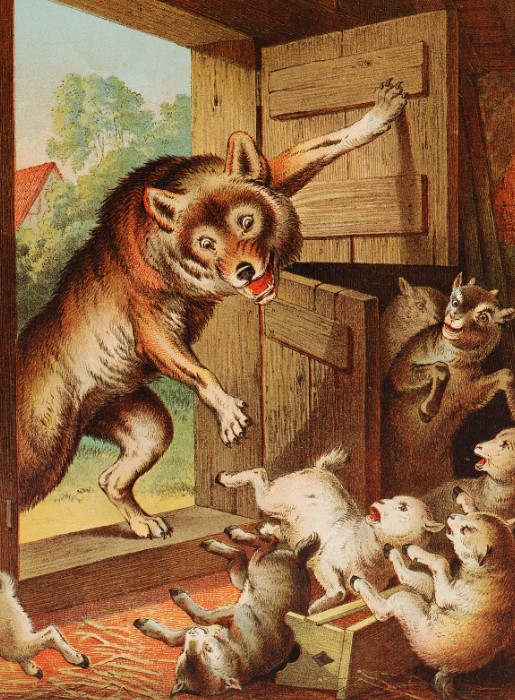
Then he put his paws in through the window, and when the kids saw that they were white, they believed that all he said was true, and opened the door. But who should come in but the wolf. The kids were terrified and wanted to hide themselves. One sprang under the table, the second into the bed, the third into the stove, the fourth into the kitchen, the fifth into the cupboard, the sixth under the washing-bowl, and the seventh into the clock-case. But the wolf found them all, and used no great ceremony, one after the other he swallowed them down his throat. The youngest, who was in the clock-case, was the only one he did not find. When the wolf had satisfied his appetite he took himself off, laid himself down under a tree in the green meadow outside, and began to sleep.
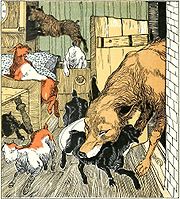
The Wolf and the Seven Kids - El Lobo y los Siete Cabritos

Soon afterwards the old goat came home again from the forest. Ah, what a sight she saw there. The house-door stood wide open. The table, chairs, and benches were thrown down, the washing-bowl lay broken to pieces, and the quilts and pillows were pulled off the bed. She sought her children, but they were nowhere to be found. She called them one after another by name, but no one answered. 
At last, when she came to the youngest, a soft voice cried, "Dear Mother, I am in the clock-case." She took the kid out, and it told her that the wolf had come and had eaten all the others. Then you may imagine how she wept over her poor children. 
At length in her grief she went out, and the youngest kid ran with her. When they came to the meadow, there lay the wolf by the tree and snored so loud that the branches shook. She looked at him on every side and saw that something was moving and struggling in his gorged belly. Ah, heavens, she thought, is it possible that my poor children whom he has swallowed down for his supper, can be still alive? 
Then the kid had to run home and fetch scissors, and a needle and thread and the goat cut open the monster's stomach, and hardly had she make one cut, than one little kid thrust its head out, and when she cut farther, all six sprang out one after another, and were all still alive, and had suffered no injury whatever, for in his greediness the monster had swallowed them down whole.

What rejoicing there was! They embraced their dear mother, and jumped like a sailor at his wedding. The mother, however, said, "Now go and look for some big stones, and we will fill the wicked beast's stomach with them while he is still asleep." Then the seven kids dragged the stones thither with all speed, and put as many of them into his stomach as they could get in, and the mother sewed him up again in the greatest haste, so that he was not aware of anything and never once stirred. 
When the wolf at length had had his fill of sleep, he got on his legs, and as the stones in his stomach made him very thirsty, he wanted to go to a well to drink.

But when he began to walk and move about, the stones in his stomach knocked against each other and rattled. Then cried he,

"What rumbles and tumbles
Against my poor bones?
I thought 'twas six kids,
But it feels like big stones."

And when he got to the well and stooped over the water to drink, the heavy stones made him fall in, and he had to drown miserably.

When the seven kids saw that, they came running to the spot and cried aloud, "The wolf is dead, the wolf is dead," and danced for joy round about the well with their mother.

By the Grimm Brothers

Thanks so much to Dennis for sending in this story.

🔆 Otros cuentos:

Adblock test (Why?)

Presente continuo - Forma Afirmativa - English grammar

presente continuo afirmativo

 ¿Cómo se forma el presente continuo? - English grammar

Sujeto + Be (en presente) + verbo terminado en ing

Ejemplo de conjugación con el verbo work en forma afirmativa:

I am working -- I'm working
you are working -- you're working

he is working -- he's working
she is working -- she's working
it is working -- it's working

we are working -- we're working
you are working -- you're working
they are working -- they're working

La terminación -ing- se añade al verbo según estas reglas:

En muchos verbos tan sólo se añade -ing- al infinitivo:

play -- playing
sing -- singing
study -- studying

Los verbos que acaban en una sola -e-, la pierden, para añadir -ing-:

take -- taking
dance -- dancing
come -- coming

En los verbos de una sola sílaba acabados en una vocal corta + una consonante, en este caso se dobla la consonante final y se añade -ing-:

cut -- cutting
run -- running
stop -- stopping

Los verbos de dos o más sílabas doblan la última consonante si el acento tónico cae en la última sílaba.

prefer -- preferring
begin -- beginning

El presente continuo es empleado para referirse a una acción que se está realizando en el momento de hablar.

What are you going? - - ¿Qué estás haciendo?
I'm reading the newspaper - - Estoy leyendo el periódico.

En algunos verbos de sentido como see / hear / smell no se utiliza el presente continuo, sino la construcción de can + infinitivo.

Can you hear me? - - ¿Me oyes?
Yes, I can hear you. - - Sí, te oigo.
I can, see the bus now.
Veo el autobús ahora.

🔆 También te puede interesar:

  • Cómo preguntar y expresar la posesión en inglés
  • Cómo usar May y might - Verbos modales
  • Conditionals in English - El condicional en Inglés
  • Adjetivos y pronombres demostrativos en Inglés
  • Pronombres Posesivos en inglés - Possessive Pronouns
  • Adjetivos Posesivos en Inglés - Possessive adjectives
  • ¿Cómo aprender inglés fácil y desde casa?
  • Plural de los sustantivos en inglés
  • Many more, a lot more y Much more. Usos en inglés
  • ¿Qué son los phrasal verbs en inglés? Los más usados
  • Cómo expresar opiniones en inglés
  • Uso de whose en inglés - Pronombres relativos
  • Who, which y that - Pronombres Relativos en inglés
  • Was going to - El futuro en el pasado
  • DO y MAKE en inglés ¿Cuáles son las diferencias?
  • Cuándo usar Since, For, Ago: ¿Cuáles son las diferencias?
  • The Gerund - El gerundio en inglés
  • El Imperativo en Inglés - Imperative
  • El comparativo y el superlativo en inglés
  • Preguntas con WH-Questions 01 - What, where, why, who
  • Preguntas con WH-Questions 02 - When, Which, Whose, How
  • Cómo expresar cantidades en inglés
  • Adjectives - Los Adjetivos en Inglés
  • Uso de some / any acompañando nombres contables/incontables
  • Modal verbs - Verbos modales en inglés
  • El tiempo futuro en inglés
  • Present Perfect Progressive - Presente perfecto progresivo
  • Present perfect - El presente perfecto inglés
  • Pretérito progresivo o continuo en inglés
  • Simple past - El pretérito o pasado simple en inglés
  • Presente continuo - Forma Afirmativa - English grammar
  • Presente continuo - Forma Negativa
  • Puntuación en inglés - All about punctuation in English
  • Los verbos Auxiliares en inglés - Auxiliary Verbs
  • Verbos irregulares en inglés, la lista que debes conocer
  • Cómo decir la fecha en inglés - How to say the date in English
  • Construir frases simples - To build a simple sentence
  • Nombres contables e incontables en inglés
  • Presente continuo - Forma Interrogativa
  • Cómo Preguntar y decir el precio en inglés

Adblock test (Why?)