domingo, 20 de marzo de 2022

How to help your children be happy?

How to help your children be happy?

We dream of educating our children in the best possible way, to make them balanced and independent and to give them all the keys to blossom in their future life. To help them grow up and become happy adults themselves, it is up to you, the parents, to educate them as much as to love them.

Setting limits for your child to help him or her develop

Although children need to be reassured and encouraged, they also need to be confronted with many limits. Accepting frustration is an essential step for them. With the use of "no" from an early age, the child learns the reality of life and integrates the basics of social rhythms, sharing, relationships with other children but also with adults and becomes aware of his place within the family.

Parents must therefore become guarantors of reality, and keep their place as adults and not as accomplices with the child. While taking into account the child's character, it is their duty to push him or her in a direction that corresponds to him or her, while instilling in him or her the values that are indispensable for life in the community.

The importance of family life for the happiness of children

It is also essential not to sacrifice the couple by giving too much space to the child. For the child to be happy, the parental model must also be happy. It is therefore important for the couple to give themselves time together and not let the children impose their rhythm at home. The family pattern: adults versus children must be clear and respected.

But it does not stop there. In order for them to blossom and therefore to be happy, children need to share moments of joy with their loved ones. Through outings, games or moments of complicity with his parents, he creates anchors to which he can unconsciously cling later. The same applies to meals. By taking part in the family dinner, the child creates reference points and offers himself moments of privileged dialogue necessary for his emotional balance.

Learning to understand your child's emotions to make them happy

Feelings and sentiments are emotional storms for adults and even more so for children. But unlike their parents, children do not know how to step back from their own emotions. It is therefore your role to help them understand and control their emotions. By taking the time to communicate and reassure them, you can help them tame their emotions and get to know themselves better. With simple questions such as "Are you sad or angry?", "Do you know why, or what triggered your reaction?

From now on, they understand and recognise their emotions and adapt to their environment. In a word, he opens up to the world around him. Impulses are better controlled, frustration is tolerated and the child feels better.

Acting calmly, and reassuring your child to help them be happy

With huge upheavals in their bodies and minds, children, especially very young ones, are particularly sensitive to the tone you use and the stress you can communicate to them. Raising your voice to defuse a difficult situation is counterproductive and will only aggravate the situation and generate useless and harmful anxiety in the child, which will remain in the child's subconscious for a long time. The best way to deal with a tantrum is to remain calm and firm in your attitude while explaining why you will not give in. Limits can be set gently and allow the child to integrate the basics that are essential to his future happiness.

If he is afraid, and even if the cause of his anxiety seems silly to you, do not scold him and take it seriously. You need to be benevolent to allow him to set up his emotional and rational neural circuitry in the best possible way.

The child, and even more so the very young child, is a real sponge for the different feelings he or she has, but also for those of his or her parents. To help them master these feelings and integrate into their new environment, they need serene and confident parents who will teach them to become fulfilled and balanced adults.


You may also like to read / También te puede interesar leer

Adblock test (Why?)

jueves, 17 de marzo de 2022

Father's Day - What makes a dad - Poems

Poesías en inglés día del padre

Poesías en inglés día del padre - Recursos Educativos en Inglés - Poems in English

Father's Day - What makes a dad

God took the strength of a mountain, 
The majesty of a tree, 
The warmth of a summer sun, 
The calm of a quiet sea,

The generous soul of nature, 
The comforting arm of night, 
The wisdom of the ages, 
The power of the eagle's flight,

The joy of a morning in spring, 
The faith of a mustard seed, 
The patience of eternity, 
The depth of a family need,

Then God combined these qualities, 
When there was nothing more to add, 
He knew His masterpiece was complete, 
And so, He called it ... Dad

Thanks so much to Marina. for sending in this poem

Recursos y materiales gratis en inglés, para el día del padre.

Adblock test (Why?)

miércoles, 16 de marzo de 2022

Cómo Preguntar el tiempo atmosférico en Inglés

clima ingles

What's the weather like? - ¿Qué tiempo hace?

Para responder se utiliza: It's + adjetivo

  1. It's hot - Hace calor
  2. It's cold - Hace frío
  3. It´s sunny - Hace sol
  4. It´s cloudy - Está nublado
  5. It´s a lovely day - Hace un día precioso

Vocabulario - Vocabulary

  • Weather - tiempo (meteorológico)
  • Hot - caluroso
  • Cold - frío
  • Sunny - soleado
  • Cloudy - nuboso
  • Lovely - precioso
  • Breeze - brisa

  • Cloudless - despejado

  • Cool - fresco

  • Damp  - húmedo

  • Dry - seco

  • Fog - niebla

  • Foggy - con niebla

  • Freezing - helado

  • Frost - escarcha

  • Mild - templado

  • Overcast - cubierto

  • Raining - lloviendo

  • Rainy  - lluvioso

  • Snowing - nevando

  • Stormy  - tormentoso

  • Stuffy  - sofocante

  • Windy - ventoso

🔆 También te puede interesar:

Adblock test (Why?)

Adjetivos y pronombres demostrativos en Inglés

Adjetivos y pronombres demostrativos en Inglés

Adjetivos y pronombres demostrativos en Inglés - Recursos Educativos en inglés

Gramática Inglesa - English Grammar

Cerca

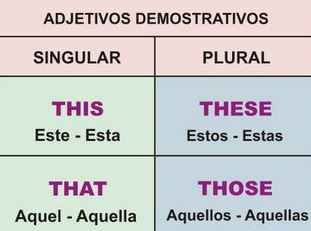
This - este, ésta, esto (singular).
These - estos, éstas (plural).

Lejos

That - ése, ésa, eso, aquel, aquella, aquello.
Those - ésos, ésas, aquéllos, aquellas.     

Actúan como adjetivos cuando acompañan al nombre, y como pronombres cuando lo sustituyen

Adjetivos demostrativos en inglés - this, that, these, those

This y that son lo que llamamos adjetivos demostrativos. Tienen el mismo significado, pero se utilizan de forma diferente, como veremos en esta lección.

En el plural, this and that se convierten en these and those.

¿Cuál es el significado de los adjetivos demostrativos?

Los adjetivos demostrativos, this y that (o en plural these y those), se utilizan para mostrar, para indicar, algo o alguien de lo que se habla.

Por ejemplo: This is a cat. 🐱

These are my sunglasses. 👓

This Vs that, ¿Qué diferencia hay?

Sí, aunque su significado sea el mismo, tienen una diferencia. Te daré una pista: es una cuestión de distancia.

Si el objeto del que hablamos está cerca, usaremos THIS (singular) o THESE (plural). Si el objeto está lejos, usamos THAT (singular) o THOSE (plural).

Utilizando el ejemplo anterior:

This is a cat - cerca.
That’s another cat - lejos.

Here is Vs there is

Here is y there is son expresiones que podemos relacionar con esta lección, porque la explicación es la misma que para THIS y THAT. También es una cuestión de distancia. Si el objeto del que hablamos está cerca, diremos Here is, y si está lejos, diremos there is.

Here is my bag - cerca

There is my bag - lejos

🔆 También te puede interesar:

  • Cómo preguntar y expresar la posesión en inglés
  • Pronombres Posesivos en inglés - Possessive Pronouns
  • Adjetivos Posesivos en Inglés - Possessive adjectives
  • ¿Cómo aprender inglés fácil y desde casa?
  • Plural de los sustantivos en inglés
  • Many more, a lot more y Much more. Usos en inglés
  • ¿Qué son los phrasal verbs en inglés? Los más usados
  • Cómo expresar opiniones en inglés
  • Uso de whose en inglés - Pronombres relativos
  • Who, which y that - Pronombres Relativos en inglés
  • Was going to - El futuro en el pasado
  • DO y MAKE en inglés ¿Cuáles son las diferencias?
  • Cuándo usar Since, For, Ago: ¿Cuáles son las diferencias?
  • The Gerund - El gerundio en inglés
  • El Imperativo en Inglés - Imperative
  • El comparativo y el superlativo en inglés
  • Preguntas con WH-Questions 01 - What, where, why, who
  • Preguntas con WH-Questions 02 - When, Which, Whose, How
  • Cómo expresar cantidades en inglés
  • Adjectives - Los Adjetivos en Inglés
  • Uso de some / any acompañando nombres contables/incontables
  • Modal verbs - Verbos modales en inglés
  • El tiempo futuro en inglés
  • Present Perfect Progressive - Presente perfecto progresivo
  • Present perfect - El presente perfecto inglés
  • Pretérito progresivo o continuo en inglés
  • Simple past - El pretérito o pasado simple en inglés
  • Presente continuo - Forma Afirmativa - English grammar
  • Presente continuo - Forma Negativa
  • Puntuación en inglés - All about punctuation in English
  • Los verbos Auxiliares en inglés - Auxiliary Verbs
  • Verbos irregulares en inglés, la lista que debes conocer
  • Cómo decir la fecha en inglés - How to say the date in English
  • Construir frases simples - To build a simple sentence
  • Nombres contables e incontables en inglés
  • Presente continuo - Forma Interrogativa
  • Cómo Preguntar y decir el precio en inglés

Adblock test (Why?)

Little Red Riding Hood - Caperucita Roja en inglés

caperucita roja ingles

Recursos Educativos en Inglés - Stories in English - Cuentos clásicos en Inglés

Little Red Riding Hood

Once upon a time there was a dear little girl who was loved by everyone who looked at her, but most of all by her grandmother, and there was nothing that she would not have given to the child. Once she gave her a little riding hood of red velvet, which suited her so well that she would never wear anything else; so she was always called 'Little Red Riding Hood.'

     One day her mother said to her: 'Come, Little Red Riding Hood, here is a piece of cake and a bottle of wine; take them to your grandmother, she is ill and weak, and they will do her good. Set out before it gets hot, and when you are going, walk nicely and quietly and do not run off the path, or you may fall and break the bottle, and then your grandmother will get nothing; and when you go into her room, don't forget to say, "Good morning", and don't peep into every corner before you do it.'

     'I will take great care,' said Little Red Riding Hood to her mother, and gave her hand on it.

     The grandmother lived out in the wood, half a league from the village, and just as Little Red Riding Hood entered the wood, a wolf met her. Red Riding Hood did not know what a wicked creature he was, and was not at all afraid of him.

     'Good day, Little Red Riding Hood,' said he.

     'Thank you kindly, wolf.'

     'Whither away so early, Little Red Riding Hood?'

     'To my grandmother's.'

     'What have you got in your apron?'

     'Cake and wine; yesterday was baking-day, so poor sick grandmother is to have something good, to make her stronger.'

     'Where does your grandmother live, Little Red Riding Hood?'

     'A good quarter of a league farther on in the wood; her house stands under the three large oak-trees, the nut-trees are just below; you surely must know it,' replied Little Red Riding Hood.

The wolf thought to himself: 'What a tender young creature! what a nice plump mouthful - she will be better to eat than the old woman. I must act craftily, so as to catch both.'

     So he walked for a short time by the side of Little Red Riding Hood, and then he said: 'See, Little Red Riding Hood, how pretty the flowers are about here - why do you not look round? I believe, too, that you do not hear how sweetly the little birds are singing; you walk gravely along as if you were going to school, while everything else out here in the wood is merry.'

     Little Red Riding Hood raised her eyes, and when she saw the sunbeams dancing here and there through the trees, and pretty flowers growing everywhere, she thought: 'Suppose I take grandmother a fresh nosegay; that would please her too. It is so early in the day that I shall still get there in good time.'

     So she ran from the path into the wood to look for flowers. And whenever she had picked one, she fancied that she saw a still prettier one farther on, and ran after it, and so got deeper and deeper into the wood.

     Meanwhile the wolf ran straight to the grandmother's house and knocked at the door.

     'Who is there?'

     'Little Red Riding Hood,' replied the wolf. 'She is bringing cake and wine; open the door.'

     'Lift the latch,' called out the grandmother, 'I am too weak, and cannot get up.'

     The wolf lifted the latch, the door sprang open, and without saying a word he went straight to the grandmother's bed, and devoured her. Then he put on her clothes, dressed himself in her cap, laid himself in bed and drew the curtains.

     Little Red Riding Hood, however, had been running about picking flowers, and when she had gathered so many that she could carry no more, she remembered her grandmother, and set out on the way to her.

She was surprised to find the cottage-door standing open, and when she went into the room, she had such a strange feeling that she said to herself: 'Oh dear! how uneasy I feel today, and at other times I like being with grandmother so much.' She called out: 'Good morning,' but received no answer; so she went to the bed and drew back the curtains. There lay her grandmother with her cap pulled far over her face, and looking very strange.

     'Oh! grandmother,' she said, 'what big ears you have!'

     'All the better to hear you with, my child,' was the reply.

     'But, grandmother, what big eyes you have!' she said.

     'All the better to see you with, my dear.'

     'But, grandmother, what large hands you have!'

     'All the better to hug you with.'

     'Oh! but, grandmother, what a terrible big mouth you have!'

     'All the better to eat you with!'

     And scarcely had the wolf said this, than with one bound he was out of bed and swallowed up Red Riding Hood.

     When the wolf had appeased his appetite, he lay down again in the bed, fell asleep and began to snore very loud.

     The huntsman was just passing the house, and thought to himself: 'How the old woman is snoring! I must just see if she wants anything.' So he went into the room, and when he came to the bed, he saw that the wolf was lying in it.

     'Do I find you here, you old sinner!' said he. 'I have long sought you!' But just as he was going to fire at him, it occurred to him that the wolf might have devoured the grandmother, and that she might still be saved, so he did not fire, but took a pair of scissors, and began to cut open the stomach of the sleeping wolf.

When he had made two snips, he saw the little red riding hood shining, and then he made two snips more, and the little girl sprang out, crying: 'Ah, how frightened I have been! How dark it was inside the wolf.'

     After that the aged grandmother came out alive also, but scarcely able to breathe. Red Riding Hood, however, quickly fetched great stones with which they filled the wolf's belly, and when he awoke, he wanted to run away, but the stones were so heavy that he collapsed at once, and fell dead.

     Then all three were delighted. The huntsman drew off the wolf's skin and went home with it; the grandmother ate the cake and drank the wine which Red Riding Hood had brought, and revived. But Red Riding Hood thought to herself: 'As long as I live, I will never leave the path by myself to run into the wood, when my mother has forbidden me to do so.'

It is also related that once, when Red Riding Hood was again taking cakes to the old grandmother, another wolf spoke to her, and tried to entice her from the path. Red Riding Hood, however, was on her guard, and went straight forward on her way, and told her grandmother that she had met the wolf, and that he had said 'good morning' to her, but with such a wicked look in his eyes, that if they had not been on the public road she was certain he would have eaten her up.

     'Well,' said the grandmother, 'we will shut the door, so that he can not come in.'

     Soon afterwards the wolf knocked, and cried: 'Open the door, grandmother, I am Little Red Riding Hood, and am bringing you some cakes.'

     But they did not speak, or open the door, so the grey-beard stole twice or thrice round the house, and at last jumped on the roof, intending to wait until Red Riding Hood went home in the evening, and then to steal after her and devour her in the darkness. But the grandmother saw what was in his thoughts.

In front of the house was a great stone trough, so she said to the child: 'Take the pail, Red Riding Hood; I made some sausages yesterday, so carry the water in which I boiled them to the trough.'

     Red Riding Hood carried until the great trough was quite full. Then the smell of the sausages reached the wolf, and he sniffed and peeped down, and at last stretched out his neck so far that he could no longer keep his footing and began to slip, and slipped down from the roof straight into the great trough, and was drowned. But Red Riding Hood went joyously home, and no one ever did anything to harm her again.

Thanks so much to Dennis for sending in this story.

🔆 Otros cuentos:

Adblock test (Why?)

Ali Baba and the Forty Thieves - Alí Babá y los Cuarenta Ladrones

Ali Baba and the Forty Thieves - Alí Babá y los Cuarenta Ladrones

Recursos Educativos en Inglés - Stories in English - Cuentos en Inglés

Ali Baba and the Forty Thieves - Alí Babá y los Cuarenta Ladrones

Once upon a time . . . in a distant Persian city lived two brothers called Ali Baba and Kasim. Ali Baba was terribly poor, and he lived with his wife in a mud hut. He picked up sticks in the woods and sold them in bundles at the market. 
Kasim, however, had a rich wife, and he lived in a big fine house and sold carpets. He became richer than ever. One day, as Ali Baba was gathering sticks in a wood some way from the city he heard a band of horsemen gallop towards him. Scared that he might be in trouble for stealing wood, he scrambled up a tree and hid amongst the foliage, seconds before the men, armed to the teeth, rode underneath. 

They were robbers, no doubt about that. Ali could tell by their evil looks, rough beards and bad language. But what made it perfectly clear to him was the booty they unloaded from their horses, obviously plundered in a raid. Their leader was a grim wicked-looking man. Followed by his men, he strode towards a rocky mountain nearby. Throwing wide his arms suddenly shouted: 
"Open sesame!" 
Ali Baba could hardly believe his eyes. For at the robber's words, the rock face swung open to become the entrance to a deep, dark cave. The robbers trooped inside, dragging their sacks. Ali Baba was struck dumb by this amazing sight, and he crouched in his tree, without moving a muscle. He could hear the robbers' voices echo in the cave, then out they came. Again opening his arms, the leader exclaimed loudly: 
"Close sesame!" And the rock swung tightly shut, as they leapt onto their horses and galloped away. Trembling with fear, Ali Baba climbed down the tree. He had just had the biggest shock of his life. Hardly aware of what he was doing, he muttered: 
"Open sesame," But the mountain stood still. Ali Baba said the words again, but this time he shouted them. Suddenly, the rock began to move. Ali Baba lit a flare and entered the cave. In front of his bulging eyes lay vast piles of treasure: pots of silver gold, precious vases, weapons studded with rubies and emeralds, diamonds, carved plates and carpets, all heaped together. 
The poverty-stricken stick-gatherer rubbed his eyes in disbelief. His hand was shaking like a leaf, as he picked up a gold coin. 
"It's real!" he said in awe. Jabbering with excitement and stunned at the sight of such untold wealth, he told himself: 
"I'll take some coins. Nobody will ever know!" And he filled four bags full. The second he reached home, Ali Baba locked the door and emptied the sacks in front of his astounded wife. 
"Count them," he ordered her triumphantly, before telling her what had happened. But there were far too many coins for these poor people to count. 
"We can't count them all. Run to my brother's house and ask him for a corn measure. We'll use that," said Ali Baba. When Kasim's wife heard this strange request, her curiosity was aroused. 
"][ wonder what they want to measure. It can't be corn, they're far too poor." And she quickly brushed a touch of tar across the bottom of the measuring pail. And when she got the pail back there was something stuck to it - as the clever woman had known there would be. It was a gold coin. 
"A gold coin. Where did that come from? They're the poorest of the poor!" And she rushed off to tell her husband. Kasim was most annoyed. 
"How dare my brother have gold coins without telling me about it," he snapped. And off he marched to ask Ali Baba for an explanation. Ali Baba innocently told Kasim his strange story, but asked him to keep it a secret. Of course, Kasim promised, but he quickly told his wife about it and ordered the servants to saddle ten sturdy mules for next morning. 
"I'll be richer than ever. Incredibly rich!" he said to himself as he went to bed. But he didn't sleep a wink for thinking of the treasure. It was still dark when Kasim and his mule train set out. When he reached the mountain, beyond the forest, he pronounced the magic words and entered the cave. With a beating heart, he crammed as much as he could into the saddle bags. But Kasim's greed led to his downfall, for the bags were so stuffed with treasure that they became too heavy to lift. Kasim realised, with a sinking feeling, that he would have to leave behind some of his precious burden. But it took him a long time, and he was still picking over what to keep and what to abandon, when . . . 
. . . as fate would have it, the robber band returned. When they saw that the entrance to the cave was open, they rushed inside with drawn swords. Unlucky Kasim was quickly discovered and killed. And the robbers were so fierce that they chopped him into four and left the pieces at the entrance. 
"That will warn any other snooper of the end that awaits him!" shouted the leader. 
Kasim's wife waited in vain for two days, then in desperation, she ran to Ali Baba and told him where her husband had gone, asking for help. Ali Baba was dismayed. 
"He promised he would never . ." However, Ali Baba was fond of his brother, so he saddled a mule and rode to the mountain. When he saw, to his horror, the remains of Kasim, he broke down and wept. Then he plucked up enough courage to wrap them in a rug, which he tied to the mule's back. But Kasim's wife, when she saw what had happened to her husband, died of a broken heart. Ali Baba and his family went to live in Kasim's palace. There he met Morgantina, a clever young slave girl who had long been a servant in the palace. It was she who told Ali Baba that his brother's remains could be put together again before being buried. Mustapha, the cobbler, would do the job, for a good reward. 
"I have to blindfold you," Morgantina told the cobbler, "so you can't see where you're going, then there won't be any gossip." The cobbler did his work well and was led, still blindfolded, back to his shop, with a bag of gold for his trouble. 
In the meantime, when the robber leader saw that the body had been removed, he knew that someone else had found the treasure trove. Angry and alarmed, he ordered one of his men to sneak into the city and find out what he could. Well, by sheer chance, the spy had a hole in the sole of his boot and he went into the cobblers. Mustapha was bursting to tell someone all about his luck... 
"...and they gave me a bag of gold for stitching the body together again." 
"If you take me to the place, I'll give you another bag of gold," said the robber immediately. The robber nearly danced for joy. Then his heart sank. How was he to find the house he had never seen. 
"I'll blindfold you again," said the robber, "then you take your time and try to remember which way you went!" As it turned out the robber was lucky, for Mustapha had an excellent sense of direction. What's more, he had counted his footsteps. So he counted them again. 
"...five hundred and ten, five hundred and eleven, five hundred and twelve. Here!" The cobbler wrenched the cloth from his eyes and found himself in front of Ali Baba's palace. The robber handed over the bag of gold and, unseen, drew a red cross on the door. Then he hurried away to give his leader the news. 
Dusk fell and, as Morgantina was about to enter the palace, she noticed the strange mark. Her suspicions aroused, she quickly drew red cross on all the other doors in the street. At dead of night the wicked band arrived to take revenge, but at the sight of all the red crosses, they stopped in their tracks. Which was the right door? Morgantina had unknowingly saved her master from death, and the leader of the gang put his man to the sword for giving him a false lead. 
"You fools. Can't you do anything properly? I'll go to the city myself." Disguised as a merchant, he went to Mustapha. Delighted at the idea of earning more money, the cobbler took the robber to Ali Baba's palace. And the wicked man fixed in his mind the exact place and street. Back in his hideout, he ordered two of his men to buy a cart and thirty nine giant jars. Now, after the murder of the messenger, there were only thirty eight robbers left, and each one hid in a jar. The last jar was filled!led with oil, and loaded with the others onto the cart pulled by four horses. The robbers set off for the city. It was late when they reached the palace and Ali Baba himself came out. 
"What can I da for you?" he said. 
"I'm an oil merchant," replied the leader, "and I must be at market tomorrow. It's late an we're weary. Can you give us a bed for the night?" Pleased at being able to help, Ali Baba, who had known what it meant to be poor, warmly welcomed the merchant and his men and had the cart taken into the courtyard. 
After a good meal, the leader of the band went back to the courtyard. He said he was going to make sure than none of the jars had been damaged during the journey, but in fact, he warned his men to be ready, at a signal, to leap from the jars and kill everyone in the palace. As the household slept, Morgantina lingered in the kitchen to tidy up. Suddenly, she thought she would have a sip of the merchant's oil to see if it was as tasty as her own. But when she lifted the lid from the first jar, to her horror, a gruff voice growled: 
¥ "Is it time?" 
"No, not yet," muttered Morgantina hastily. At every jar, exactly the same thing happened, but the last one was filled with oil, which she dragged back into the kitchen. She then tipped the contents into a huge cauldron and heated it over the fire. Then, taking a jugful of boiling oil, Morgantina poured it over the head of a robber. She then poured the oil over every one of the robbers and, in this way, wiped out the whole band. Then she hid in a corner. A little later, the leader of the robber band hurried into the courtyard to give the signal to attack. But when he raised the lids, he found to his terror that every one of his men was dead. Horrified, he could not fathom what trap he had fallen into. The robber fled into the night. 
Next morning, Morgantina told Ali Baba of her adventure. 
"I'll never be able to thank you enough!" exclaimed Ali Baba. "You are an amazing girl. From this second you are no longer a slave, but a free member of this household." The dead men were buried under cover of darkness, and Ali Baba was sure he had nothing more to fear. The leader of the robber band, however, had recovered from his shock and was eager for revenge. So he shaved off his beard, changed his looks and disguised himself as a carpet seller. At the market, he met Tabit, Ali Baba s son, who took a liking to him. 
"Sooner or later this silly chap will invite me home," said the false carpet seller, "then I can murder them all." 
"That merchant has sold you some fine carpets very cheaply, remarked Ali Baba to his son. "Ask him to come to the house." When Morgantina saw the guest, she felt sure his face was familiar. Then she remembered. The carpet seller and the leader of the band were one and the same person. Without saying a word, she went back to the kitchen, but later she asked All Baba if she might dance for the guest. 
"If you like," said Ali Baba. When coffee was served, Morgantina entered in D a swirl ofF veils to the beat of her tambourine. In her right hand she held a knife. As she stopped dancing, she thrust the knife into the carpet seller's heart. 
"He's one of the robbers!" she cried. "I know his face. He would have killed us all." Morgantina had once more saved their lives! Tabit hugged her, little knowing that his joy would soon turn to love and that they would marry. Ali Baba was the only person left who knew the secret of the treasure. He made wise use of it for many years, but he never told anyone the magic words that would open the cave of the Forty Thieves.

🔆 Otros cuentos:

Adblock test (Why?)

The Ugly Duckling - El Patito Feo

The Ugly Duckling - El Patito Feo

Recursos Educativos en Inglés - Stories in English - Cuentos en Inglés

The Ugly Duckling - El Patito Feo

Once upon a time. . . down on an old farm, lived a duck family, and Mother Duck had been sitting on a clutch of new eggs. One nice morning, the eggs hatched and out popped six chirpy ducklings. But one egg was bigger than the rest, and it didn't hatch. Mother Duck couldn't recall laying that seventh egg. How did it get there? TOCK! TOCK! The little prisoner was pecking inside his shell. 
"Did I count the eggs wrongly?" Mother Duck wondered. But before she had time to think about it, the last egg finally hatched. A strange looking duckling with grey feathers that should have been yellow gazed at a worried mother. The ducklings grew quickly, but Mother Duck had a secret worry. 

"I can't understand how this ugly duckling can be one of mine!" she said to herself, shaking her head as she looked at her lastborn. Well, the grey duckling certainly wasn't pretty, and since he ate far more than his brothers, he was outgrowing them. As the days went by, the poor ugly duckling became more and more unhappy. His brothers didn't want to play with him, he was so clumsy, and all the farmyard folks simply laughed at him. He felt sad and lonely, while Mother Duck did her best to console him. 

"Poor little ugly duckling!" she would say. "Why are you so different from the others?" And the ugly duckling felt worse than ever. He secretly wept at night. He felt nobody wanted him. 
"Nobody loves me, they all tease me! Why am I different from my brothers?" 
Then one day, at sunrise, he ran away from the farmyard. He stopped at a pond and began to question all the other birds. "Do you know of any ducklings with grey feathers like mine?" But everyone shook their heads in scorn. 
"We don't know anyone as ugly as you." The ugly duckling did not lose heart, however, and kept on making enquiries. He went to another pond, where a pair of large geese gave him the same answer to his question. What's more, they warned him: "Don't stay here! Go away! It's dangerous. There are men with guns around here!" The duckling was sorry he had ever left the farmyard. 
Then one day, his travels took him near an old countrywoman's cottage. Thinking he was a stray goose, she caught him. 
"I'll put this in a hutch. I hope it's a female and lays plenty of eggs!" said the old woman, whose eyesight was poor. But the ugly duckling laid not a single egg. The hen kept frightening him: 
"Just wait! If you don't lay eggs, the old woman will wring your neck and pop you into the pot!" And the cat chipped in: "Hee! Hee! I hope the woman cooks you, then I can gnaw at your bones!" The poor ugly duckling was so scared that he lost his appetite, though the old woman kept stuffing him with food and grumbling: "If you won't lay eggs, at least hurry up and get plump!" 
"Oh, dear me!" moaned the now terrified duckling. "I'll die of fright first! And I did so hope someone would love me!" 
Then one night, finding the hutch door ajar, he escaped. Once again he was all alone. He fled as far away as he could, and at dawn, he found himself in a thick bed of reeds. "If nobody wants me, I'll hid here forever." There was plenty a food, and the duckling began to feel a little happier, though he was lonely. One day at sunrise, he saw a flight of beautiful birds wing overhead. White, with long slender necks, yellow beaks and large wings, they were migrating south. 
"If only I could look like them, just for a day!" said the duckling, admiringly. Winter came and the water in the reed bed froze. The poor duckling left home to seek food in the snow. He dropped exhausted to the ground, but a farmer found him and put him in his big jacket pocket. 
"I'll take him home to my children. They'll look after him. Poor thing, he's frozen!" The duckling was showered with kindly care at the farmer's house. In this way, the ugly duckling was able to survive the bitterly cold winter. 
However, by springtime, he had grown so big that the farmer decided: "I'll set him free by the pond!" That was when the duckling saw himself mirrored in the water. 
"Goodness! How I've changed! I hardly recognize myself!" The flight of swans winged north again and glided on to the pond. When the duckling saw them, he realized he was one of their kind, and soon made friends. 
"We're swans like you!" they said, warmly. "Where have you been hiding?" 
"It's a long story," replied the young swan, still astounded. Now, he swam majestically with his fellow swans. One day, he heard children on the river bank exclaim: "Look at that young swan! He's the finest of them all!" 
And he almost burst with happiness.

By Hans Christian Anderston

🔆 Otros cuentos:

Adblock test (Why?)