jueves, 24 de marzo de 2022

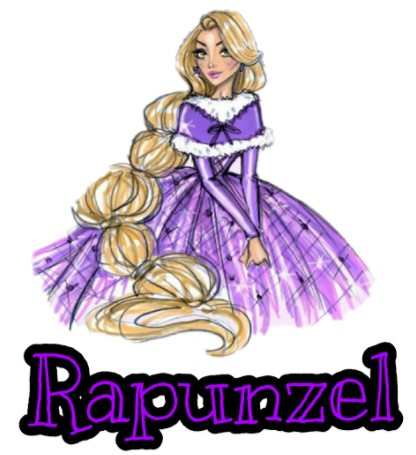
Rapunzel - Brothers Grimm - Cuento en inglés

rapunzel cuento

Recursos Educativos en Inglés - Stories in English - Cuentos clásicos en Inglés

Rapunzel, Brothers Grimm

There were once a man and a woman who had long, in vain, wished for a child. At length it appeared that God was about to grant their desire.

     These people had a little window at the back of their house from which a splendid garden could be seen, which was full of the most beautiful flowers and herbs. It was, however, surrounded by a high wall, and no one dared to go into it because it belonged to an enchantress, who had great power and was dreaded by all the world.

     One day the woman was standing by this window and looking down into the garden, when she saw a bed which was planted with the most beautiful rampion, and it looked so fresh and green that she longed for it. She quite pined away, and began to look pale and miserable.

     Her husband was alarmed, and asked: 'What ails you, dear wife?'

     'Ah,' she replied, 'if I can't eat some of the rampion, which is in the garden behind our house, I shall die.'

     The man, who loved her, thought: 'Sooner than let your wife die, bring her some of the rampion yourself, let it cost what it will.'

     At twilight, he clambered down over the wall into the garden of the enchantress, hastily clutched a handful of rampion, and took it to his wife. She at once made herself a salad of it, and ate it greedily. It tasted so good to her - so very good, that the next day she longed for it three times as much as before.

     If he was to have any rest, her husband knew he must once more descend into the garden. Therefore, in the gloom of evening, he let himself down again; but when he had clambered down the wall he was terribly afraid, for he saw the enchantress standing before him.

     'How can you dare,' said she with angry look, 'descend into my garden and steal my rampion like a thief? You shall suffer for it!'

 'Ah,' answered he, 'let mercy take the place of justice, I only made up my mind to do it out of necessity. My wife saw your rampion from the window, and felt such a longing for it that she would have died if she had not got some to eat.'

     The enchantress allowed her anger to be softened, and said to him: 'If the case be as you say, I will allow you to take away with you as much rampion as you will, only I make one condition, you must give me the child which your wife will bring into the world; it shall be well treated, and I will care for it like a mother.'

     The man in his terror consented to everything.

     When the woman was brought to bed, the enchantress appeared at once, gave the child the name of Rapunzel, and took it away with her.

     Rapunzel grew into the most beautiful child under the sun. When she was twelve years old, the enchantress shut her into a tower in the middle of a forest. The tower had neither stairs nor door, but near the top was a little window. When the enchantress wanted to go in, she placed herself beneath it and cried:

'Rapunzel, Rapunzel, 
Let down your hair to me.'

     Rapunzel had magnificent long hair, fine as spun gold, and when she heard the voice of the enchantress, she unfastened her braided tresses, wound them round one of the hooks of the window above, and then the hair fell twenty ells down, and the enchantress climbed up by it.

     After a year or two, it came to pass that the king's son rode through the forest and passed by the tower. Then he heard a song, which was so charming that he stood still and listened. It was Rapunzel, who in her solitude passed her time in letting her sweet voice resound. The king's son wanted to climb up to her, and looked for the door of the tower, but none was to be found. He rode home, but the singing had so deeply touched his heart, that every day he went out into the forest and listened to it.

Once when he was thus standing behind a tree, he saw that an enchantress came there, and he heard how she cried:

'Rapunzel, Rapunzel, 
Let down your hair to me.'

     Then Rapunzel let down the braids of her hair, and the enchantress climbed up to her.

     'If that is the ladder by which one mounts, I too will try my fortune,' said he, and the next day when it began to grow dark, he went to the tower and cried:

'Rapunzel, Rapunzel, 
Let down your hair to me.'

     Immediately the hair fell down and the king's son climbed up.

     At first Rapunzel was terribly frightened when a man, such as her eyes had never yet beheld, came to her; but the king's son began to talk to her quite like a friend, and told her that his heart had been so stirred that it had let him have no rest, and he had been forced to see her. Then Rapunzel lost her fear, and when he asked her if she would take him for her husband, and she saw that he was young and handsome, she thought: 'He will love me more than old Dame Gothel does'; and she said yes, and laid her hand in his.

     She said: 'I will willingly go away with you, but I do not know how to get down. Bring with you a skein of silk every time that you come, and I will weave a ladder with it, and when that is ready I will descend, and you will take me on your horse.'

     They agreed that until that time he should come to her every evening, for the old woman came by day. The enchantress remarked nothing of this, until once Rapunzel said to her: 'Tell me, Dame Gothel, how it happens that you are so much heavier for me to draw up than the young king's son - he is with me in a moment.'

'Ah! you wicked child,' cried the enchantress. 'What do I hear you say! I thought I had separated you from all the world, and yet you have deceived me!'

     In her anger she clutched Rapunzel's beautiful tresses, wrapped them twice round her left hand, seized a pair of scissors with the right, and snip, snap, they were cut off, and the lovely braids lay on the ground. And she was so pitiless that she took poor Rapunzel into a desert where she had to live in great grief and misery.

     On the same day that she cast out Rapunzel, however, the enchantress fastened the braids of hair, which she had cut off, to the hook of the window, and when the king's son came and cried:

'Rapunzel, Rapunzel, 
Let down your hair to me.'

     she let the hair down. The king's son ascended, but instead of finding his dearest Rapunzel, he found the enchantress, who gazed at him with wicked and venomous looks.

     'Aha!' she cried mockingly, 'you would fetch your dearest, but the beautiful bird sits no longer singing in the nest; the cat has got it, and will scratch out your eyes as well. Rapunzel is lost to you; you will never see her again.'

     The king's son was beside himself with pain, and in his despair he leapt down from the tower. He escaped with his life, but the thorns into which he fell pierced his eyes.

     He wandered quite blind about the forest, ate nothing but roots and berries, and did naught but lament and weep over the loss of his dearest wife. Thus he roamed about in misery for some years, and at length came to the desert where Rapunzel, with the twins to which she had given birth, a boy and a girl, lived in wretchedness. He heard a voice, and it seemed so familiar to him that he went towards it, and when he approached, Rapunzel knew him and fell on his neck and wept. Two of her tears wetted his eyes and they grew clear again, and he could see with them as before. He led her to his kingdom where he was joyfully received, and they lived for a long time afterwards, happy and contented.

Thanks so much to Dennis for sending in this story.

🔆 Otros cuentos:

Adblock test (Why?)

martes, 22 de marzo de 2022

The Three Little Pigs - Los Tres Cerditos

The Three Little Pigs - Los Tres Cerditos

Recursos Educativos en Inglés - Stories in English - Cuentos en Inglés

The Three Little Pigs - Los Tres Cerditos

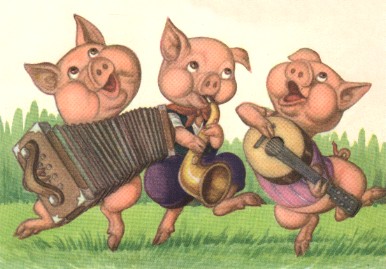
Once upon a time . . . there were three little pigs, who left their mummy and daddy to see the world.

All summer long, they roamed through the woods and over the plains,playing games and having fun. None were happier than the three little pigs, and they easily made friends with everyone. Wherever they went, they were given a warm welcome, but as summer drew to a close, they realized that folk were drifting back to their usual jobs, and preparing for winter. Autumn came and it began to rain. The three little pigs started to feel they needed a real home. Sadly they knew that the fun was over now and they must set to work like the others, or they'd be left in the cold and rain, with no roof over their heads. They talked about what to do, but each decided for himself. The laziest little pig said he'd build a straw hut. 
"It wlll only take a day,' he said. The others disagreed. 

"It's too fragile," they said disapprovingly, but he refused to listen. Not quite so lazy, the second little pig went in search of planks of seasoned wood. 
"Clunk! Clunk! Clunk!" It took him two days to nail them together. But the third little pig did not like the wooden house. 
"That's not the way to build a house!" he said. "It takes time, patience and hard work to build a house that is strong enough to stand up to wind, rain, and snow, and most of all, protect us from the wolf!" 
The days went by, and the wisest little pig's house took shape, brick by brick. From time to time, his brothers visited him, saying with a chuckle: 
"Why are you working so hard? Why don't you come and play?" But the stubborn bricklayer pig just said "no". 
"I shall finish my house first. It must be solid and sturdy. And then I'll come and play!" he said. "I shall not be foolish like you! For he who laughs last, laughs longest!" 
It was the wisest little pig that found the tracks of a big wolf in the neighbourhood. 
The little pigs rushed home in alarm. Along came the wolf, scowling fiercely at the laziest pig's straw hut. 
"Come out!" ordered the wolf, his mouth watering. I want to speak to you!" 
"I'd rather stay where I am!" replied the little pig in a tiny voice. 
"I'll make you come out!" growled the wolf angrily, and puffing out his chest, he took a very deep breath. Then he blew with all his might, right onto the house. And all the straw the silly pig had heaped against some thin poles, fell down in the great blast. Excited by his own cleverness, the wolf did not notice that the little pig had slithered out from underneath the heap of straw, and was dashing towards his brother's wooden house. When he realized that the little pig was escaping, the wolf grew wild with rage. 
"Come back!" he roared, trying to catch the pig as he ran into the wooden house. The other little pig greeted his brother, shaking like a leaf. 
"I hope this house won't fall down! Let's lean against the door so he can't break in!" 
Outside, the wolf could hear the little pigs' words. Starving as he was, at the idea of a two-course meal, he rained blows on the door. 
"Open up! Open up! I only want to speak to you!" 
Inside, the two brothers wept in fear and did their best to hold the door fast against the blows. Then the furious wolf braced himself a new effort: he drew in a really enormous breath, and went ... WHOOOOO! The wooden house collapsed like a pack of cards. 
Luckily, the wisest little pig had been watching the scene from the window of his own brick house, and he rapidly opened the door to his fleeing brothers. And not a moment too soon, for the wolf was already hammering furiously on the door. This time, the wolf had grave doubts. This house had a much more solid air than the others. He blew once, he blew again and then for a third time. But all was in vain. For the house did not budge an lnch. The three little pigs watched him and their fear began to fade. Quite exhausted by his efforts, the wolf decided to try one of his tricks. He scrambled up a nearby ladder, on to the roof to have a look at the chimney. However, the wisest little pig had seen thls ploy, and he quickly said: 
"Quick! Light the fire!" With his long legs thrust down the chimney, the wolf was not sure if he should slide down the black hole. It wouldn't be easy to get in, but the sound of the little pigs' voices below only made him feel hungrier. 
"I'm dying of hunger! I'm goin to try and get down." And he let himself drop. But landing was rather hot, too hot! The wolf landed in the fire, stunned by his fall. 
The flames licked his hairy coat and his tail became a flaring torch. 
"Never again! Never again will I go down a chimneyl" he squealed, as he tried to put out the flames in his tail. Then he ran away as fast as he could. 
The three happy little pigs, dancing round and round the yard, began to sing: 
"Tra-la-la! Tra-la-la! The wicked black wolf will never come back...!" 
From that terrible day on, the wisest little pig's brothers set to work with a will. In less than no time, up went the two new brick houses. The wolf did return once to roam in the neighbourhood, but when he caught sight of three chimneys, he remembered the terrible pain of a burnt tail, and he left for good. 
Now safe and happy, the wisest little pig called to his brothers:

"No more work! Come on, let's go and play!"

🔆 Otros cuentos:

Adblock test (Why?)

Poems Of Langston Hughes - Poemas en inglés

langston hughes

Poems Of Langston Hughes - Recursos Educativos en Inglés - Poems in English - Poesías en inglés

Theme For English B - Langston Hughes

The instructor said,

Go home and write
a page tonight.
And let that page come out of you—
Then, it will be true.

I wonder if it’s that simple?
I am twenty-two, colored, born in Winston-Salem.
I went to school there, then Durham, then here
to this college on the hill above Harlem.
I am the only colored student in my class.
The steps from the hill lead down into Harlem,
through a park, then I cross St. Nicholas,
Eighth Avenue, Seventh, and I come to the Y,
the Harlem Branch Y, where I take the elevator
up to my room, sit down, and write this page:

It’s not easy to know what is true for you or me
at twenty-two, my age. But I guess I’m what
I feel and see and hear, Harlem, I hear you.
hear you, hear me—we two—you, me, talk on this page.
(I hear New York, too.) Me—who?

Well, I like to eat, sleep, drink, and be in love.
I like to work, read, learn, and understand life.
I like a pipe for a Christmas present,
or records—Bessie, bop, or Bach.
I guess being colored doesn’t make me not like
the same things other folks like who are other races.
So will my page be colored that I write?
Being me, it will not be white.
But it will be
a part of you, instructor.
You are white—
yet a part of me, as I am a part of you.
That’s American.
Sometimes perhaps you don’t want to be a part of me.
Nor do I often want to be a part of you.
But we are, that’s true!
As I learn from you,
I guess you learn from me—
although you’re older—and white—
and somewhat more free.

This is my page for English B.

Dream Deferred - Langston Hughes

What happens to a dream deferred?

Does it dry up
Like a raisin in the sun?

Or fester like a sore--
And then run?

Does it stink like rotten meat?
Or crust and sugar over--
like a syrupy sweet?

Maybe it just sags
like a heavy load.

Or does it explode?

Mother To Son - Langston Hughes

Well, son, I'll tell you:
Life for me ain't been no crystal stair.
It's had tacks in it,
And splinters,
And boards torn up,
And places with no carpet on the floor-
Bare.
But all the time
I'se been a-climbin' on,
And reachin' landin's,
And turnin' corners,
And sometimes goin' in the dark
Where there ain't been no light.
So, boy, don't you turn back.
Don't you set down on the steps.
'Cause you finds it's kinder hard.
Don't you fall now-
For I'se still goin', honey,
I'se still climbin',
And life for me ain't been no crystal stair.

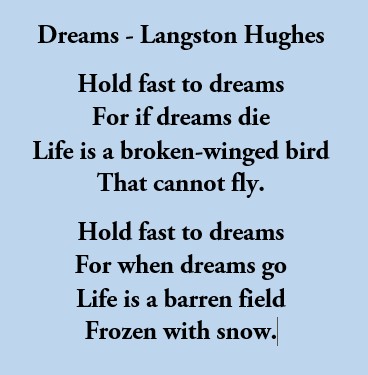
Dreams - Langston Hughes

Hold fast to dreams
For if dreams die
Life is a broken-winged bird
That cannot fly.

Hold fast to dreams
For when dreams go
Life is a barren field
Frozen with snow.

🔆 Read more Poems

Adblock test (Why?)

Personalidad - Personality - English Vocabulary

personalidad personality

Recursos Educativos en inglés

Vocabulario en Inglés - English Vocabulary

En inglés existen multitud de adjetivos y términos, todos ellos destinados a describir mejor una personalidad.

Personalidad - Personality

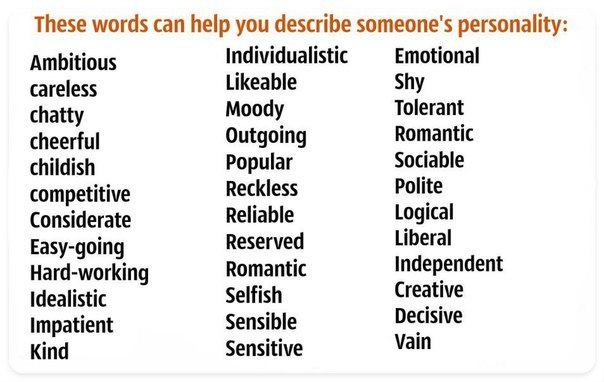
These words can help you describe someone’s personality:

Ambitious - ambicioso

Conceited – vanidoso/a

Cruel – cruel

Cynical – cínico/a

Careless - descuidado

Chatty - hablador

Bad–tempered – de mal carácter

Bitchy – malvado/a

Boring – aburrido/a

Dishonest – poco honesto/a

Disloyal – desleal

Eccentric – excéntrico/a

Envious – envidioso/a

Bossy– mandón/a

Cheeky – atrevido/a

Clumsy – torpe

Competitive – competitivo/a

Hard–working – aplicado/a, trabajador/a

Hearty – cordial, amable

Helpful – que aporta ayuda

Cheerful - alegre

Childish - infantil

Disrespectful – irrespetuoso/a

Dominant – dominante

Dowdy – que no se arregla

Dull – aburrido/a

Competitive - Competitivo

Considerate - considerado

Easy-going – fácil de llevar, de buen trato

Hard-working - trabajador

Idealistic - idealista

Impatient - impaciente

Passionate – apasionado/a

Pleasant – amable, complaciente

Polite – educado/a

Kind – amable, atento

Individualistic - individualista

Likeable - simpático

Joyful – alegre

Kind – amable

Loyal – fiel

Modest – modesto/a

Open–minded – abierto/a de miras

Cool – guay, enrollado/a

Reliable – que puedes confiar en esta persona

Smart – listo/a

Moody - malhumorado

Outgoing – cordial, extrovertido

Popular - popular

Sympathetic – comprensivo/a

Witty – agudo/a en el sentido de ingenioso/a

Sneering – burlón/a

Thoughtful – considerado/a

Aggressive – agresivo/a

Annoying – molesto/a, que molesta

Reckless - temerario

Reserved - reservado

Romantic - romántico

Selfish - egoísta

Sensible - razonable

Sensitive - sensible

Emotional - emocional

Clever – listo/a

Cheerful – alegre

Coherent – coherente

Shy – tímido, vergonzoso

Tolerant - tolerante

Romantic - romántico

Sociable - sociable

Polite - cortés

Logical - lógico

Liberal - liberal

Nice – agradable

Gentle – amable, educado/a

Obliging – atento/a

Saucy – atrevido/a

Independent - independiente

Creative - creativo

Decisive - decisivo

Vain – egoísta, superficial

Fussy – exigente

Greedy – codicioso/a

Hesitant – inseguro/a

Amusing – divertido/a

Brave – valiente

Calm – tranquilo/a, calmado/a

Cautious – prudente

Charming – encantador/a

Cunning – astuto/a

Introverted – introvertido/a

Insolent – insolente

Jealous – celoso/a

Lazy -perezoso/a

Lonely – solitario/a

Crafty – pícaro/a

Confident – confiado de él/ella mismo/a

Enthusiastic – entusiasta

Generous – generoso/a

Fair – justo/a

Funny – divertido/a

Intelligent – inteligente

Cabe señalar que, en lo que respecta a los adjetivos, son invariables, ya sea que se describa a una mujer o a un hombre. Por ejemplo, para decir "ella es feliz", uno diría "she's pleased", así como para un hombre, uno diría "he's pleased". Bastante simple, ¿no?

¿Qué son los adjetivos en inglés y por qué son tan importantes?

Un adjetivo es una palabra usada para calificar un sustantivo, es decir, para darle información adicional.

Por ejemplo: a coffee => a hot coffee, a good coffee, etc.

Por lo tanto, los adjetivos en inglés son esenciales para expresarse. Cuanto más sepas, mejor podrás expresarte.

Cursos de inglés niveles básico, intermedio, avanzado

Adblock test (Why?)

lunes, 21 de marzo de 2022

Good Morning - Canciones para Niños en Inglés: Rutinas

Good Morning - Canciones para Niños en Inglés: Rutinas

Canciones para Niños en Inglés: Rutinas - Songs for Children in English: Routines

Good Morning

Good morning,
Good morning.
Good afternoon,
Good afternoon.
Good evening,
Good evening,
Good night!

Hello, hello, hello, hello.
Hello, hello, hello, hello!

Hello, hello, hello, hello.
Hello, hello, hello, hello!

( Repeat Chorus)

Hello, hello, hello, hello.
Hello, hello, hello, hello!

Hello, hello, hello, hello.
Hello, hello, hello, hello!

by Richard Graham & Will Jasprizza

Thanks so much to nany83 for sending in this song!

Canciones para niños en inglés para trabajar las rutinas diarias, vuelta al cole, saludar, recoger, hacer silencio, etc. Ideales para favorecer el aprendizaje del idioma, adquirir vocabulario, practicar la pronunciación, etc.

Canciones infantiles en inglés - Rutinas

Adblock test (Why?)

domingo, 20 de marzo de 2022

Spring - Spring flowers - Poems

poesias estaciones del año en ingles

Recursos Educativos en Inglés - Poems in English

Poesías en inglés estaciones del año

Spring - Spring flowers

Look, Spring the season of flowers has come.
Blue flowers, red flowers, yellow flowers and pink.
Blue flowers, red flowers, yellow flowers and pink,
Look, it has come.

Look, Spring the season of flowers has come.
Purple flowers, green flowers, orange flowers and maroon.
Purple flowers, green flowers, orange flowers and maroon,
Look, it has come.

Look, Spring the season of flowers has come.

Thanks so much to Dennis. for sending in this poem

🔆 Read more Poems

Adblock test (Why?)

Spring - Butterfly, Butterfly - Poems

poesias estaciones del año en ingles

Recursos Educativos en Inglés - Poems in English

Poesías en inglés estaciones del año

Spring - Butterfly, Butterfly

Butterfly, butterfly,
Whence do you come?
I know not, I ask not,
Nor ever had a home.

Butterfly, butterfly,
Where do you go?
Where the sun shines,
And where the buds grow.

Thanks so much to Dennis. for sending in this poem

🔆 Read more Poems

Adblock test (Why?)