sábado, 26 de marzo de 2022

Poems Of About Edgar Guest - Poemas en inglés

edgar guest

Recursos Educativos en Inglés - Poems in English - Poesías en inglés

Story Telling - Edgar Guest

Most every night when they're in bed,
And both their little prayers have said,
They shout for me to come upstairs
And tell them tales of gypsies bold,
And eagles with the claws that hold
A baby's weight, and fairy sprites
That roam the woods on starry nights.

And I must illustrate these tales,
Must imitate the northern gales
That toss the native man's canoe,
And show the way he paddles, too.
If in the story comes a bear,
I have to pause and sniff the air
And show the way he climbs the trees
To steal the honey from the bees.

And then I buzz like angry bees
And sting him on his nose and knees
And howl in pain, till mother cries:
"That pair will never shut their eyes,
While all that noise up there you make;
You're simply keeping them awake."
And then they whisper: "Just one more,"
And once again I'm forced to roar.

New stories every night they ask.
And that is not an easy task;
I have to be so many things,
The frog that croaks, the lark that sings,
The cunning fox, the frightened hen;
But just last night they stumped me, when
They wanted me to twist and squirm
And imitate an angle worm.

At last they tumble off to sleep,
And softly from their room I creep
And brush and comb the shock of hair
I tossed about to be a bear.
Then mother says: "Well, I should say
You're just as much a child as they."
But you can bet I'll not resign
That story telling job of mine.

Being Brave At Night - Edgar Guest

The other night 'bout two o'clock, or maybe it was three,
An elephant with shining tusks came chasing after me.
His trunk was wavin' in the air an' spoutin' jets of steam
An' he was out to eat me up, but still I didn't scream
Or let him see that I was scared - a better thought I had,
I just escaped from where I was and crawled in bed with dad.

One time there was a giant who was horrible to see,
He had three heads and twenty arms, an' he came after me
And red hot fire came from his mouths and every hand was red
And he declared he'd grind my bones and make them into bread.
But I was just too smart for him, I fooled him might bad,
Before his hands could collar me I crawled in bed with dad.

I ain't scared of nothin that comes pesterin' me at night.
Once I was chased by forty ghosts all shimmery an' white.
An' I just raced 'em round the room an' let 'em think maybe
I'd have to stop an' rest awhile, when they could capture me.
Then when they leapt onto my bed, Oh Gee! But they were mad
To find that I had slipped away an' crawled in bed with dad.

No giants, ghosts or elephants have dared to come in there
'Coz if they did he'd beat 'em up and chase 'em to their lair.
They just hang 'round the children's rooms
an' snap an' snarl an' bite
An' laugh if they can make 'em yell
for help with all their might.
But I don't ever yell out loud. I'm not that sort of lad,
I slip from out the covers and I crawl in bed with dad.

The Stick-Together Families - Edgar Guest

The stick-together families are happier by far
Than the brothers and the sisters who take separate highways are.
The gladdest people living are the wholesome folks who make
A circle at the fireside that no power but death can break.
And the finest of conventions ever held beneath the sun
Are the little family gatherings when the busy day is done.

There are rich folk, there are poor folk, who imagine they are wise,
And they're very quick to shatter all the little family ties.
Each goes searching after pleasure in his own selected way,
Each with strangers likes to wander, and with strangers likes to play.
But it's bitterness they harvest, and it's empty joy they find,
For the children that are wisest are the stick-together kind.

There are some who seem to fancy that for gladness they must roam,
That for smiles that are the brightest they must wander far from home.
That the strange friend is the true friend, and they travel far astray
they waste their lives in striving for a joy that's far away,
But the gladdest sort of people, when the busy day is done,
Are the brothers and the sisters who together share their fun.

It's the stick-together family that wins the joys of earth,
That hears the sweetest music and that finds the finest mirth;
It's the old home roof that shelters all the charm that life can give;
There you find the gladdest play-ground, there the happiest spot to live.
And, O weary, wandering brother, if contentment you would win,
Come you back unto the fireside and be comrade with your kin.

Equipment - Edgar Guest

Figure it out for yourself, my lad,
You've all that the greatest of men have had,
Two arms, two hands, two legs, two eyes,
And a brain to use if you would be wise.
With this equipment they all began,
So start for the top and say "I can."

Look them over, the wise and great,
They take their food from a common plate
And similar knives and forks they use,
With similar laces they tie their shoes,
The world considers them brave and smart.
But you've all they had when they made their start.

You can triumph and come to skill,
You can be great if only you will,
You're well equipped for what fight you choose,
You have legs and arms and a brain to use,
And the man who has risen, great deeds to do
Began his life with no more than you.

You are the handicap you must face,
You are the one who must choose your place,
You must say where you want to go.
How much you will study the truth to know,
God has equipped you for life, But He
Lets you decide what you want to be.

Courage must come from the soul within,
The man must furnish the will to win,
So figure it out for yourself, my lad,
You were born with all that the great have had,
With your equipment they all began.
Get hold of yourself, and say: "I can."

See It Through - Edgar Guest

When you’re up against a trouble,
Meet it squarely, face to face;
Lift your chin and set your shoulders,
Plant your feet and take a brace.
When it’s vain to try to dodge it,
Do the best that you can do;
You may fail, but you may conquer,
See it through!

Black may be the clouds about you
And your future may seem grim,
But don’t let your nerve desert you;
Keep yourself in fighting trim.
If the worst is bound to happen,
Spite of all that you can do,
Running from it will not save you,
See it through!

Even hope may seem but futile,
When with troubles you’re beset,
But remember you are facing
Just what other men have met.
You may fail, but fall still fighting;
Don’t give up, whate’er you do;
Eyes front, head high to the finish.
See it through!

🔆 Read more Poems

Adblock test (Why?)

Poems Of Abbie Farwell Brown - Poemas en inglés

abbie farwell brown

Recursos Educativos en Inglés - Poems in English - Poesías en inglés

Friends - Abbie Farwell Brown

How good to lie a little while
And look up through the tree!
The Sky is like a kind big smile
Bent sweetly over me.

The Sunshine flickers through the lace
Of leaves above my head,
And kisses me upon the face
Like Mother, before bed.

The Wind comes stealing o'er the grass
To whisper pretty things;
And though I cannot see him pass,
I feel his careful wings.

So many gentle Friends are near
Whom one can scarcely see,
A child should never feel a fear,
Wherever he may be.

The Fisherman - Abbie Farwell Brown

The fisherman goes out at dawn
When every one's abed,
And from the bottom of the sea
Draws up his daily bread.

His life is strange ; half on the shore
And half upon the sea
Not quite a fish, and yet not quite
The same as you and me.

The fisherman has curious eyes;
They make you feel so queer,
As if they had seen many things
Of wonder and of fear.

They're like the sea on foggy days,
Not gray, nor yet quite blue;
They 're like the wondrous tales he tells
Not quite yet maybe true.

He knows so much of boats and tides,
Of winds and clouds and sky!
But when I tell of city things,
He sniffs and shuts one eye!

🔆 Read more Poems

Adblock test (Why?)

viernes, 25 de marzo de 2022

Poems Of William Blake - Poemas en inglés

willian blake

Recursos Educativos en Inglés - Poems in English - Poesías en inglés

The Tyger - Poems - William Blake

Tyger! Tyger! burning bright
In the forests of the night,
What immortal hand or eye
Could frame thy fearful symmetry?

In what distant deeps or skies
Burnt the fire of thine eyes?
On what wings dare he aspire?
What the hand dare seize the fire?

And what shoulder, and what art,
Could twist the sinews of thy heart?
And when thy heart began to beat,
What dread hand? and what dread feet?

What the hammer? what the chain?
In what furnace was thy brain?
What the anvil? what dread grasp
Dare its deadly terrors clasp?

When the stars threw down their spears,
And watered heaven with their tears,
Did he smile his work to see?
Did he who made the Lamb make thee?

Tyger! Tyger! burning bright
In the forests of the night,
What immortal hand or eye,
Dare frame thy fearful symmetry?

The Sick Rose - William Blake

O Rose, thou art sick!
The invisible worm
That flies in the night,
In the howling storm,
Has found out thy bed
Of crimson joy:
And his dark secret love
Does thy life destroy.

A Cradle Song - William Blake

Sweet dreams form a shade
O'er my lovely infant's head;
Sweet dreams of pleasant streams
By happy, silent, moony beams.

Sweet sleep with soft down
Weave thy brows an infant crown.
Sweet sleep, Angel mild,
Hover o'er my happy child.

Sweet smiles in the night
Hover over my delight;
Sweet smiles, Mother's smiles,
All the livelong night beguiles.

Sweet moans, dovelike sighs,
Chase not slumber from thy eyes.
Sweet moans, sweeter smiles,
All the dovelike moans beguiles.

Sleep sleep, happy child,
All creation slept and smil'd;
Sleep sleep, happy sleep,
While o'er thee thy mother weep.

Sweet babe, in thy face
Holy image I can trace.
Sweet babe, once like thee,
Thy maker lay and wept for me,

Wept for me for thee for all,
When he was an infant small.
Thou his image ever see.
Heavenly face that smiles on thee,

Smiles on thee on me on all,
Who became an infant small,
Infant smiles are His own smiles,
Heaven & earth to peace beguiles.

On Another's Sorrow - William Blake

Can I see another's woe,
And not be in sorrow too?
Can I see another's grief,
And not seek for kind relief?

Can I see a falling tear,
And not feel my sorrow's share?
Can a father see his child
Weep, nor be with sorrow filled?

Can a mother sit and hear
An infant groan, an infant fear?
No, no! never can it be!
Never, never can it be!
And can He who smiles on all
Hear the wren with sorrows small,
Hear the small bird's grief and care,
Hear the woes that infants bear --

And not sit beside the next,
Pouring pity in their breast,
And not sit the cradle near,
Weeping tear on infant's tear?

And not sit both night and day,
Wiping all our tears away?
Oh no! never can it be!
Never, never can it be!
He doth give his joy to all:
He becomes an infant small,
He becomes a man of woe,
He doth feel the sorrow too.

Think not thou canst sigh a sigh,
And thy Maker is not by:
Think not thou canst weep a tear,
And thy Maker is not near.

Oh He gives to us his joy,
That our grief He may destroy:
Till our grief is fled an gone
He doth sit by us and moan.

Thanks so much to Dennis, for sending in this poem

🔆 Read more Poems

Adblock test (Why?)

Poems Of Sara Teasdale - Poemas en inglés

sara teasdale

Recursos Educativos en Inglés - Poems in English - Poesías en inglés

May - Sara Teasdale

The wind is tossing the lilacs,
The new leaves laugh in the sun,
And the petals fall on the orchard wall,
But for me the spring is done.

Beneath the apple blossoms
I go a wintry way,
For love that smiled in April
Is false to me in May.

The Kiss - Sara Teasdale

I hoped that he would love me,
And he has kissed my mouth,
But I am like a stricken bird
That cannot reach the south.

For though I know he loves me,
To-night my heart is sad;
His kiss was not so wonderful
As all the dreams I had.

Barter - Sara Teasdale

Life has loveliness to sell,
All beautiful and splendid things,
Blue waves whitened on a cliff,
Soaring fire that sways and sings,
And children's faces looking up
Holding wonder like a cup.

Life has loveliness to sell,
Music like a curve of gold,
Scent of pine trees in the rain,
Eyes that love you, arms that hold,
And for your spirit's still delight,
Holy thoughts that star the night.

Spend all you have for loveliness,
Buy it and never count the cost;
For one white singing hour of peace
Count many a year of strife well lost,
And for a breath of ecstasy
Give all you have been, or could be.

I Am Not Yours - Sara Teasdale

I am not yours, not lost in you,
Not lost, although I long to be
Lost as a candle lit at noon,
Lost as a snowflake in the sea.

You love me, and I find you still
A spirit beautiful and bright,
Yet I am I, who long to be
Lost as a light is lost in light.

Oh plunge me deep in love - put out
My senses, leave me deaf and blind,
Swept by the tempest of your love,
A taper in a rushing wind.

🔆 Read more Poems

Adblock test (Why?)

Poems Of Maya Angelou - Poemas en inglés

maya angelou

Recursos Educativos en Inglés - Poems in English - Poesías en inglés

Alone - Maya Angelou

Lying, thinking
Last night
How to find my soul a home
Where water is not thirsty
And bread loaf is not stone
I came up with one thing
And I don’t believe I’m wrong
That nobody,
But nobody
Can make it out here alone.

Alone, all alone
Nobody, but nobody
Can make it out here alone.

There are some millionaires
With money they can't use
Their wives run round like banshees
Their children sing the blues
They've got expensive doctors
To cure their hearts of stone.
But nobody
No, nobody
Can make it out here alone.

Alone, all alone
Nobody, but nobody
Can make it out here alone.

Now if you listen closely
I'll tell you what I know
Storm clouds are gathering
The wind is gonna blow
The race of man is suffering
And I can hear the moan,
'Cause nobody,
But nobody
Can make it out here alone.

Alone, all alone
Nobody, but nobody
Can make it out here alone.

Human Family - Maya Angelou

I note the obvious differences
in the human family.
Some of us are serious,
some thrive on comedy.

Some declare their lives are lived
as true profundity,
and others claim they really live
the real reality.

The variety of our skin tones
can confuse, bemuse, delight,
brown and pink and beige and purple,
tan and blue and white.

I've sailed upon the seven seas
and stopped in every land,
I've seen the wonders of the world
not yet one common man.

I know ten thousand women
called Jane and Mary Jane,
but I've not seen any two
who really were the same.

Mirror twins are different
although their features jibe,
and lovers think quite different thoughts
while lying side by side.

We love and lose in China,
we weep on England's moors,
and laugh and moan in Guinea,
and thrive on Spanish shores.

We seek success in Finland,
are born and die in Maine.
In minor ways we differ,
in major we're the same.

I note the obvious differences
between each sort and type,
but we are more alike, my friends,
than we are unalike.

We are more alike, my friends,
than we are unalike.

We are more alike, my friends,
than we are unalike.

Still I Rise - Maya Angelou

You may write me down in history
With your bitter, twisted lies,
You may tread me in the very dirt
But still, like dust, I'll rise.

Does my sassiness upset you?
Why are you beset with gloom?
'Cause I walk like I've got oil wells
Pumping in my living room.

Just like moons and like suns,
With the certainty of tides,
Just like hopes springing high,
Still I'll rise.

Did you want to see me broken?
Bowed head and lowered eyes?
Shoulders falling down like teardrops.
Weakened by my soulful cries.

Does my haughtiness offend you?
Don't you take it awful hard
'Cause I laugh like I've got gold mines
Diggin' in my own back yard.

You may shoot me with your words,
You may cut me with your eyes,
You may kill me with your hatefulness,
But still, like air, I'll rise.

Does my sexiness upset you?
Does it come as a surprise
That I dance like I've got diamonds
At the meeting of my thighs?

Out of the huts of history's shame
I rise
Up from a past that's rooted in pain
I rise
I'm a black ocean, leaping and wide,
Welling and swelling I bear in the tide.
Leaving behind nights of terror and fear
I rise
Into a daybreak that's wondrously clear
I rise
Bringing the gifts that my ancestors gave,
I am the dream and the hope of the slave.
I rise
I rise
I rise.

Phenomenal Woman - Maya Angelou

Pretty women wonder where my secret lies.
I'm not cute or built to suit a fashion model's size
But when I start to tell them,
They think I'm telling lies.
I say,
It's in the reach of my arms
The span of my hips,
The stride of my step,
The curl of my lips.
I'm a woman
Phenomenally.
Phenomenal woman,
That's me.

I walk into a room
Just as cool as you please,
And to a man,
The fellows stand or
Fall down on their knees.
Then they swarm around me,
A hive of honey bees.
I say,
It's the fire in my eyes,
And the flash of my teeth,
The swing in my waist,
And the joy in my feet.
I'm a woman
Phenomenally.
Phenomenal woman,
That's me.

Men themselves have wondered
What they see in me.
They try so much
But they can't touch
My inner mystery.
When I try to show them
They say they still can't see.
I say,
It's in the arch of my back,
The sun of my smile,
The ride of my breasts,
The grace of my style.
I'm a woman

Phenomenally.
Phenomenal woman,
That's me.

Now you understand
Just why my head's not bowed.
I don't shout or jump about
Or have to talk real loud.
When you see me passing
It ought to make you proud.
I say,
It's in the click of my heels,
The bend of my hair,
the palm of my hand,
The need of my care,
'Cause I'm a woman
Phenomenally.
Phenomenal woman,
That's me.

🔆 Read more Poems

Adblock test (Why?)

jueves, 24 de marzo de 2022

Poems Of Elizabeth Bishop - Poemas en inglés

elizabeth bishop

Recursos Educativos en Inglés - Poems in English - Poesías en inglés

One Art - Elizabeth Bishop

The art of losing isn’t hard to master;
so many things seem filled with the intent
to be lost that their loss is no disaster.

Lose something every day. Accept the fluster
of lost door keys, the hour badly spent.
The art of losing isn’t hard to master.

Then practice losing farther, losing faster:
places, and names, and where it was you meant
to travel. None of these will bring disaster.

I lost my mother’s watch. And look! my last, or
next-to-last, of three loved houses went.
The art of losing isn’t hard to master.

I lost two cities, lovely ones. And, vaster,
some realms I owned, two rivers, a continent.
I miss them, but it wasn’t a disaster.

—Even losing you (the joking voice, a gesture
I love) I shan’t have lied. It’s evident
the art of losing’s not too hard to master
though it may look like (Write it!) like disaster.

The Fish - Elizabeth Bishop

I caught a tremendous fish
and held him beside the boat
half out of water, with my hook
fast in a corner of his mouth.
He didn’t fight.
He hadn’t fought at all.
He hung a grunting weight,
battered and venerable
and homely. Here and there
his brown skin hung in strips
like ancient wallpaper,
and its pattern of darker brown
was like wallpaper:
shapes like full-blown roses
stained and lost through age.
He was speckled with barnacles,
fine rosettes of lime,
and infested
with tiny white sea-lice,
and underneath two or three
rags of green weed hung down.
While his gills were breathing in
the terrible oxygen
—the frightening gills,
fresh and crisp with blood,
that can cut so badly—
I thought of the coarse white flesh
packed in like feathers,
the big bones and the little bones,
the dramatic reds and blacks
of his shiny entrails,
and the pink swim-bladder
like a big peony.
I looked into his eyes
which were far larger than mine
but shallower, and yellowed,
the irises backed and packed
with tarnished tinfoil
seen through the lenses
of old scratched isinglass.
They shifted a little, but not
to return my stare.
—It was more like the tipping
of an object toward the light.
I admired his sullen face,
the mechanism of his jaw,
and then I saw
that from his lower lip
—if you could call it a lip—
grim, wet, and weaponlike,
hung five old pieces of fish-line,
or four and a wire leader
with the swivel still attached,
with all their five big hooks
grown firmly in his mouth.
A green line, frayed at the end
where he broke it, two heavier lines,
and a fine black thread
still crimped from the strain and snap
when it broke and he got away.
Like medals with their ribbons
frayed and wavering,
a five-haired beard of wisdom
trailing from his aching jaw.
I stared and stared
and victory filled up
the little rented boat,
from the pool of bilge
where oil had spread a rainbow
around the rusted engine
to the bailer rusted orange,
the sun-cracked thwarts,
the oarlocks on their strings,
the gunnels—until everything
was rainbow, rainbow, rainbow!
And I let the fish go.

🔆 Read more Poems

Adblock test (Why?)

The Twelve Dancing Princesses - Brothers Grimm

twelve dancing princesses

Recursos Educativos en Inglés - Stories in English - Cuentos clásicos en Inglés

The Twelve Dancing Princesses - Brothers Grimm - Las doce princesas bailarinas en inglés

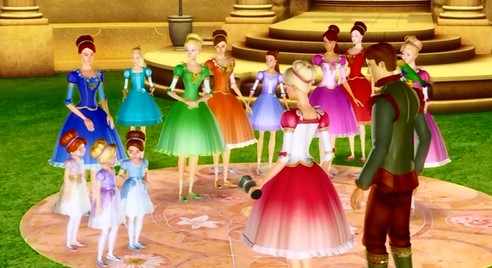
There was a king who had twelve beautiful daughters. They slept in twelve beds all in one room and when they went to bed, the doors were shut and locked up. However, every morning their shoes were found to be quite worn through as if they had been danced in all night. Nobody could find out how it happened, or where the princesses had been.

     So the king made it known to all the land that if any person could discover the secret and find out where it was that the princesses danced in the night, he would have the one he liked best to take as his wife, and would be king after his death. But whoever tried and did not succeed, after three days and nights, they would be put to death.

     A king's son soon came. He was well entertained, and in the evening was taken to the chamber next to the one where the princesses lay in their twelve beds. There he was to sit and watch where they went to dance; and, in order that nothing could happen without him hearing it, the door of his chamber was left open. But the king's son soon fell asleep; and when he awoke in the morning he found that the princesses had all been dancing, for the soles of their shoes were full of holes.

     The same thing happened the second and third night and so the king ordered his head to be cut off.

     After him came several others; but they all had the same luck, and all lost their lives in the same way.

     Now it happened that an old soldier, who had been wounded in battle and could fight no longer, passed through the country where this king reigned, and as he was travelling through a wood, he met an old woman, who asked him where he was going.

     'I hardly know where I am going, or what I had better do,' said the soldier; 'but I think I would like to find out where it is that the princesses dance, and then in time I might be a king.'

 'Well,' said the old woman, 'that is not a very hard task: only take care not to drink any of the wine which one of the princesses will bring to you in the evening; and as soon as she leaves you pretend to be fast asleep.'

     Then she gave him a cloak, and said, 'As soon as you put that on you will become invisible, and you will then be able to follow the princesses wherever they go.' When the soldier heard all this good advice, he was determined to try his luck, so he went to the king, and said he was willing to undertake the task.

     He was as well received as the others had been, and the king ordered fine royal robes to be given him; and when the evening came he was led to the outer chamber.

     Just as he was going to lie down, the eldest of the princesses brought him a cup of wine; but the soldier threw it all away secretly, taking care not to drink a drop. Then he laid himself down on his bed, and in a little while began to snore very loudly as if he was fast asleep.

     When the twelve princesses heard this they laughed heartily; and the eldest said, 'This fellow too might have done a wiser thing than lose his life in this way!' Then they rose and opened their drawers and boxes, and took out all their fine clothes, and dressed themselves at the mirror, and skipped about as if they were eager to begin dancing.

     But the youngest said, 'I don't know why it is, but while you are so happy I feel very uneasy; I am sure some mischance will befall us.'

     'You simpleton,' said the eldest, 'you are always afraid; have you forgotten how many kings' sons have already watched in vain? And as for this soldier, even if I had not given him his sleeping draught, he would have slept soundly enough.'

When they were all ready, they went and looked at the soldier; but he snored on, and did not stir hand or foot: so they thought they were quite safe.

     Then the eldest went up to her own bed and clapped her hands, and the bed sank into the floor and a trap-door flew open. The soldier saw them going down through the trap-door one after another, the eldest leading the way; and thinking he had no time to lose, he jumped up, put on the cloak which the old woman had given him, and followed them.

     However, in the middle of the stairs he trod on the gown of the youngest princess, and she cried out to her sisters, 'All is not right; someone took hold of my gown.'

     'You silly creature!' said the eldest, 'it is nothing but a nail in the wall.'

     Down they all went, and at the bottom they found themselves in a most delightful grove of trees; and the leaves were all of silver, and glittered and sparkled beautifully. The soldier wished to take away some token of the place; so he broke off a little branch, and there came a loud noise from the tree. Then the youngest daughter said again, 'I am sure all is not right -- did not you hear that noise? That never happened before.'

     But the eldest said, 'It is only our princes, who are shouting for joy at our approach.'

     They came to another grove of trees, where all the leaves were of gold; and afterwards to a third, where the leaves were all glittering diamonds. And the soldier broke a branch from each; and every time there was a loud noise, which made the youngest sister tremble with fear. But the eldest still said it was only the princes, who were crying for joy.

     They went on till they came to a great lake; and at the side of the lake there lay twelve little boats with twelve handsome princes in them, who seemed to be waiting there for the princesses.

One of the princesses went into each boat, and the soldier stepped into the same boat as the youngest. As they were rowing over the lake, the prince who was in the boat with the youngest princess and the soldier said, 'I do not know why it is, but though I am rowing with all my might we do not get on so fast as usual, and I am quite tired: the boat seems very heavy today.'

     'It is only the heat of the weather,' said the princess, 'I am very warm, too.'

     On the other side of the lake stood a fine, illuminated castle from which came the merry music of horns and trumpets. There they all landed, and went into the castle, and each prince danced with his princess; and the soldier, who was still invisible, danced with them too. When any of the princesses had a cup of wine set by her, he drank it all up, so that when she put the cup to her mouth it was empty. At this, too, the youngest sister was terribly frightened, but the eldest always silenced her.

     They danced on till three o'clock in the morning, and then all their shoes were worn out, so that they were obliged to leave. The princes rowed them back again over the lake (but this time the soldier placed himself in the boat with the eldest princess); and on the opposite shore they took leave of each other, the princesses promising to come again the next night.

     When they came to the stairs, the soldier ran on before the princesses, and laid himself down. And as the twelve, tired sisters slowly came up, they heard him snoring in his bed and they said, 'Now all is quite safe'. Then they undressed themselves, put away their fine clothes, pulled off their shoes, and went to bed.

     In the morning the soldier said nothing about what had happened, but determined to see more of this strange adventure, and went again on the second and third nights. Everything happened just as before: the princesses danced till their shoes were worn to pieces, and then returned home. On the third night the soldier carried away one of the golden cups as a token of where he had been.

As soon as the time came when he was to declare the secret, he was taken before the king with the three branches and the golden cup; and the twelve princesses stood listening behind the door to hear what he would say.

     The king asked him. 'Where do my twelve daughters dance at night?'

     The soldier answered, 'With twelve princes in a castle underground.' And then he told the king all that had happened, and showed him the three branches and the golden cup which he had brought with him.

     The king called for the princesses, and asked them whether what the soldier said was true and when they saw that they were discovered, and that it was of no use to deny what had happened, they confessed it all.

     So the king asked the soldier which of the princesses he would choose for his wife; and he answered, 'I am not very young, so I will have the eldest.' -- and they were married that very day, and the soldier was chosen to be the king's heir.

🔆 Otros cuentos:

Adblock test (Why?)