martes, 29 de marzo de 2022

Recipe for Mona de Pascua - Easter

recipe for making Mona de Pascua

Cooking recipes - How to Mona de pascua recipe?

Mona de Pascua is a typical recipe for Holy Week and Easter in many Spanish regions, such as Valencia, Catalonia, Murcia, Aragon and the Balearic Islands. It is usually a tradition that the godfather gives the mona to his godchild on Easter Sunday and that several families get together on Easter Monday to eat the mona together.

How to make homemade Mona de Pascua

Ingredients:

  • 500 g flour
  • 1 sachet of dry baker's yeast (12 g) or 25 g of fresh yeast (if you can't find yeast, you can substitute it with 1 tablespoon of bicarbonate of soda and the juice of ½ lemon)
  • 1/4 litre of warm milk
  • 100 g melted butter
  • 80 g sugar
  • 1 egg
  • 1 pinch of salt

To "paint" the dough

  • 1 egg yolk
  • 1 tablespoon of milk

For the decoration

  • Coloured anisettes, chocolate balls, sultanas, cherries for decoration, sliced almonds...
  • Boiled eggs painted with food colouring or chocolate eggs.

Steps for making mona de pascua:

  1. Put the flour in a bowl. Add the dry yeast and mix well with a fork. Add the rest of the ingredients: the butter (previously melted in the microwave), the milk, the sugar, the egg and a pinch of salt.
  2. If you do not have yeast: mix the flour, butter, sugar, milk, egg and a pinch of salt. Once the mixture is homogeneous, add the juice of half a lemon and a spoonful of bicarbonate and again stir well to mix everything together.
  3. Knead it and shape the dough into a round shape with your hands, leaving a dough like the one in the image.
  4. Cover the bowl with a cloth and put it in the oven for about 20-30 minutes at a maximum temperature of 50 degrees, leaving the oven door ajar with a wooden spoon, until we see that the dough has risen, that is, that it has visibly increased in volume. It can also be heated in the microwave by covering the bowl with a damp cloth at 80-90 watts for about 8 minutes.
  5. While the dough is rising, cover a baking tray with baking paper. Once the dough has risen, divide it into 4 or 5 parts depending on the number of "monas" you want to make and the size. Here we have to let our imagination run wild to shape the dough into the figures we want: A rabbit, a turtle, a nest, a plait, but you can make as many as you can think of, decorating with coloured balls, painted boiled eggs, slivered almonds, sugar...
  6. Put them in the oven for another 10 minutes at a maximum temperature of 50 degrees, so that the dough continues to rise. Once we have our figures ready, we mix an egg yolk with a spoonful of milk and paint the monkeys with this mixture, so that they brown in the oven. We add any decoration we can think of to finish our figures, for example, we use sultanas for the eyes, a cherry for the nose, coloured balls, chocolate balls and sliced almonds to decorate.
  7. With our figures ready and decorated, we put them in the oven preheated to 200º for about 25-30 minutes, until we see that they are ready and have taken a suitable colour.
  8. Take them out of the oven, leave them to cool, add the painted or chocolate eggs as decoration and our Easter cakes are ready to eat. Aren't they "cute"?
  9. To eat them, we can spread them with butter, jam, a bit of cheese... Accompanied by a hot chocolate, we have a great breakfast or snack for Easter, or for any occasion.

🔆 Other recipes

Adblock test (Why?)

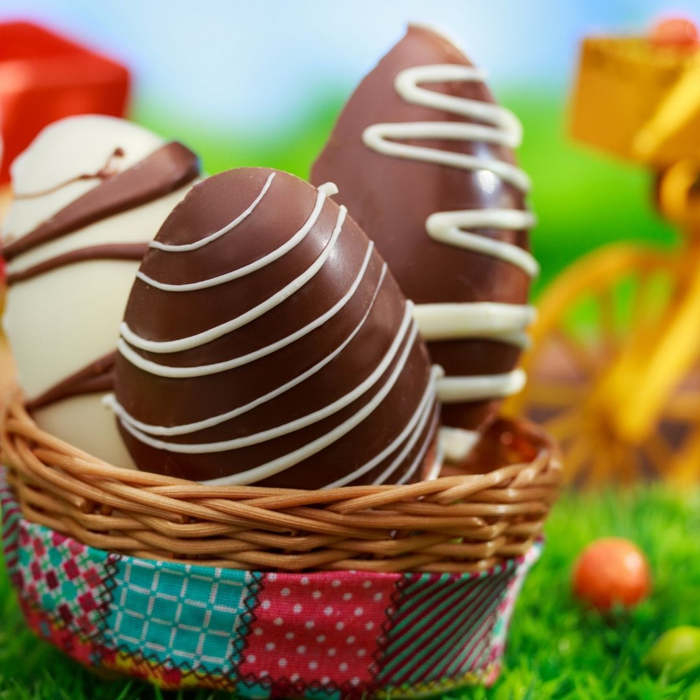
Recipe for chocolate Easter eggs

recipe for making chocolate Easter eggs

Cooking recipes - How to make chocolate Easter eggs?

Making homemade chocolate eggs is not that complicated! The proof is in the pudding with this
quick and easy recipe.

The main thing is to temper the chocolate well so that it is smooth and shiny. Children will enjoy decorating the eggs as they see fit. Dark chocolate,
white or milk chocolate, you can choose your favourite flavours.

A great way to celebrate Easter

Ingredients for the chocolate Easter eggs:

For 2 large eggs:

  • 500 g chocolate (dark, milk, white)

Steps for making chocolate Easter eggs:

1. Pour the crushed chocolate into a container. Melt in a bain-marie or in the microwave
without exceeding 45-50°C. Mix well so that the chocolate is smooth.

2. Pour the melted chocolate onto a cold plate or marble to cool to 25°C.
When the temperature is reached, return the chocolate to a container and heat to 30- 32°C.
32°C.

3. Using a small ladle, pour some of the chocolate into your mould. Turn the mould over to remove the excess chocolate. Place the mould in the refrigerator for a few hours so that the chocolate
the chocolate to harden.

4. After the resting time, carefully remove the egg shells from the mould. To weld them together, place one of the one of the shells over a pan of hot water. When the chocolate is slightly melted, weld the shells together.
When the chocolate is slightly melted, weld the shells together. Leave to dry for a few hours at room temperature.

Tip: Children can decorate these chocolate eggs in many different ways. You can for example, melt some of the chocolate and place it in a paper cone or a baking pen.
All they have to do is draw on the shells: arabesques, dots, flowers...

🔆 Other recipes

Adblock test (Why?)

Easter - Pascua en inglés - Banco de Recursos

Pascua - Easter - Fechas Especiales

Pascua - Easter Celebraciones - Celebrations

Recursos y materiales gratis en inglés, para Pascua - Easter.

Easter: the Christian story of Easter

The Christian festival of Easter is the celebration of the resurrection of Jesus Christ. In the early days of Christianity, Christian Easter coincided with the Jewish Easter. At that time the calendar used to fix the date of Easter was the Jewish or Babylonian calendar. The resurrection of Jesus Christ fell on the 14th day of Nissan at the same time as Pesach, the Jewish Passover.

The Council of Nicaea in 325 and the beginning of the differences

Constantine I convened the Council of Nicaea in 325 where it was decided that all Christians would celebrate Easter on the first Sunday after the full moon following the spring equinox. To avoid confusion with the Jewish festival, Easter was to be shifted by one week in years when the equinox corresponded to Pesach.

Alexandria wanted to keep the date of 14 Nissan as Easter, while Rome wanted Easter to fall on a Sunday, regardless of the Babylonian calendar. This also made it possible to clearly distinguish Christian Easter from Passover.

In practice, the shifts of the Julian calendar with the solar and lunar year did not allow the Christians to respect the terms of the council. The date of Easter varied according to the regions of the world. On several occasions, Rome tried to reform the method of calculating the date of Easter, but each time it met with resistance from certain churches, such as the Church of Ireland.

It was not until the reform of the Gregorian calendar that a new common rule was adopted around 1582.

The calculation of the date of Easter remains a complex one, since Easter falls on the first Sunday after the first full ecclesiastical moon in spring. In addition, Easter must fall between 22 March and 25 April.

The highlights of Easter for Christians

The Easter period is marked by several highlights for Christians which are Lent, Palm Sunday, Good Friday and Easter Sunday.

Lent :

Preparations for Easter begin at the end of Shrove Tuesday with Ash Wednesday, which marks the beginning of Lent. On Ash Wednesday, Christians go to church for the distribution of Ashes. It is a day of self-examination and repentance. Ashes remind us that man is dust and will return to dust.

Lent was strictly observed until the beginning of the 20th century. For 40 days, equivalent to the 40 days spent by Jesus Christ in the desert, Christians follow a half fast during which certain rich and meaty foods are forbidden. The period of Lent is a time of purification and spiritual elevation in preparation for the resurrection of Jesus Christ.

Palm Sunday:

Palm Sunday precedes Easter Sunday and celebrates the arrival of Jesus in Jerusalem. Jesus was celebrated on his arrival, with people spreading palm branches under his feet as a carpet.

On Palm Sunday, Christians have branches of palm, boxwood or yew blessed, which are supposed to protect them from evil throughout the year. These branches are often decorated with sugar or marzipan decorations. In English-speaking countries this is called Willow, Yew or Blossom Sunday.

Good Friday

Good Friday is a very important day in the Christian religion, but also a very sad one as it commemorates the crucifixion of Christ.

Good Friday is the Friday after Palm Sunday, the day Jesus Christ died on the cross. It is the saddest and darkest day in Christianity. Therefore, Christians all over the world follow the Way of the Cross of Jesus Christ. Each station is an opportunity to recall an important stage of his ordeal and to pray.

Easter Sunday:

Easter Day celebrates the resurrection of Jesus Christ. It is the day when Jesus' disciples went to his tomb to find it empty. On their way back they met the risen Jesus and began to spread the good news.

Easter is a day of celebration and joy. All the prohibitions of Lent are lifted on this day. The Easter period is called the Paschal season. Traditionally, the Paschal lamb is eaten on Easter Day.

Where does the custom of Easter eggs come from?

From the simple coloured hard-boiled egg to the most prestigious Fabergé eggs, the Easter egg has remained a tradition throughout the world. In Italy, Easter eggs are still blessed and placed in the centre of the table. Russian and Ukrainian Easter eggs are real works of art, with very symbolic and geometric designs and colours, with Christian representations such as the cross and Christ himself.

In the West, in the countryside or in the gardens of the city house, a mysterious egg hunt is organised in the early hours of Easter morning. According to tradition, on their way back from Rome, the bells, which have been silent since Maundy Thursday evening, spread eggs, bells, casseroles and other delicacies. The custom of giving chocolate eggs or bunnies is of commercial origin.

Pascua - Easter - Fechas Especiales

The German tradition is to hide them in an invisible white rabbit for children. In the United States and Alsace, it is a hare; in Thuringia, a stork; in Westphalia, a fox; in Switzerland, a cuckoo.

Ancient origins

The custom of giving decorated, dyed or worked eggs existed long before the Christian era. As spring is the season of nature's blossoming, the egg, representing life and rebirth, was probably the first symbol used in rituals dating back to ancient times. In spring, the Egyptians and Persians used to dye eggs and offer them as a symbol of the renewal of life. In ancient Gaul, the druids dyed eggs red in honour of the sun.

For the Jews, the egg is the symbol of life but also of death. The liberation of the Hebrew people cost many lives, and happiness is never absolute for the Hebrews. At Passover, Jews dip an egg in salt water in memory of all the tears shed after the loss of their independence.

A Christian custom

Many pagan festivals therefore celebrated the resurrection of nature symbolised by the egg, the bearer of a life-giving seed. But it was most probably the Church's ban on eating eggs during Lent until the 17th century that gave rise to the Easter egg tradition. As the hens could not be prevented from laying eggs, they were carefully kept until Easter, when the stock had to be sold!

Adblock test (Why?)

domingo, 27 de marzo de 2022

Modal verbs - Verbos modales en inglés

¿Cuándo usamos Modal verbs - Verbos modales en inglés?

¿Qué son los verbos modales?

En inglés, los modales (plural de modal) no son palabras que deban interpretarse como si tuvieran un significado. Más que significar algo, los modales ingleses tienen una función.

Para hacer una comparación, tomemos la palabra -de-. por si sola no tiene ningún significado, porque es una palabra que tiene una función. En cambio, si digo "es la casa de Elena", entonces entendemos el significado de la palabra (la casa pertenece a Elena).

Lo mismo ocurre con los modales. Cada modalidad tiene una o varias funciones particulares.

Para entender los modales, primero haremos una lista de modales y explicaremos cómo se comportan en las frases: se comportan como auxiliares. Luego veremos qué funciones realizan.

Lista de verbos modales

Hay 9 modales:

  1. Can
  2. Could
  3. May
  4. Might
  5. Must
  6. Should
  7. Will
  8. Would
  9. Shall

Las tres peculiaridades de los modales 

Cuando construyas una frase con un modal, debes respetar estas tres reglas:

1) Son invariables. Sea cual sea el tiempo de la frase, el sujeto de la misma, los modales se escribirán siempre de la misma manera. Por ejemplo:

I Could
You Could
He Could
We Could
You Could
They Could

Esto no debe confundirse con los verbos "normales" que llevan una S en la tercera persona del singular en tiempo presente (por ejemplo: she reads). Con los modales, siempre es igual.

2) Van seguidos de una base verbal. Es decir, un verbo, en infinitivo, sin el TO delante. Por ejemplo:

I can call you the monday. Puedo llamarte el lunes.

No se utiliza "To call". Solo CALL.

Esta base verbal también es invariable. No cambia, sea cual sea el sujeto.

3) Se comportan como auxiliares (porque SON auxiliares) en oraciones negativas e interrogativas. Así que no necesitas los auxiliares DO, HAVE o BE.

Esto significa que nunca dirás "I don’t may". Dirás "I may not". Del mismo modo, al hacer una pregunta, nunca dirás "¿Do you will...?", sino que dirás "¿Will you...?".

Esta es la lista de formas negativas de los modales:

  1. May - may not
  2. Might - might not
  3. Can - can’t o cannot
  4. Could - couldn’t o could not
  5. Must - mustn’t o must not
  6. Should - shouldn’t o should not
  7. Will - won’t o will not
  8. Would - wouldn’t o would not

Para las formas interrogativas, simplemente se invierte el sujeto y el modal.

I will - will you…?
I might - might I…?
I can - can you…?

¿Qué funciones tiene cada modalidad?

Los modales pueden tener una o varias funciones según el contexto. Aquí tienes un resumen general.

May

Forma afirmativa: expresa la probabilidad 

Lo que puede ocurrir: It may snow again tomorrow. Puede que mañana vuelva a nevar.

Lo que puede ser cierto: What you’re saying may be true. Lo que dices puede ser cierto.

También puede expresar permiso: You may eat now. Ya puedes comer.

Forma negativa: May not

Lo que no puede ocurrir.

Lo que puede no ser cierto.

También puede expresar una prohibición categórica. You may not eat here. No se puede comer aquí.

Forma interrogativa: May I…?

En una pregunta, may se utiliza para pedir permiso, pero de una forma aún más educada que con can y could. - May I eat here?

Might

Forma afirmativa:

El modal Might es un sinónimo de may. What you’re saying might be true. Lo que dices puede ser cierto.

Forma negativa:

Might not.

Forma interrogativa:

Una petición aún más educada que con MAY (raramente se ve).

Can

Forma afirmativa:

Lo que uno es capaz de hacer: I can read this book. Puedo leer este libro (soy capaz).

Lo que está permitido: I can go out tomorrow. Puedo salir mañana (se me permite).

Forma negativa:

Cannot o can't.

Lo que no puedes hacer.
Lo que está prohibido.

Forma interrogativa:

Can I…?

Pedir permiso o hacer una petición. Dad, can I go to the theater tomorrow? - Papá, ¿puedo ir al teatro mañana?

Could

Forma afirmativa:

Lo que uno podría hacer: If I had a pool, I could swim. Si tuviera una piscina, podría nadar.

Qué podría pasar si...

Could también puede ser el tiempo pasado de - can -.I could see you. Te pude ver.

Forma negativa

Could not o couldn’t

Similar a la forma afirmativa. I couldn't see you. No pude verte.

Forma interrogativa:

Pedir un favor o un permiso de forma educada. Could you help me?

Must

Forma afirmativa:

 El modal Must transmite un deber, una obligación. Lo que debes hacer.- I must clean my house today. Hoy debo limpiar mi casa.

Must también puede expresar una certeza. It must be half past five. - Sin duda, deben ser las 5 y media.

Forma negativa:

Mustn't o must not.

Esta forma expresa una prohibición.

Should:

Forma afirmativa:

El modal should expresa un deber, como must, pero con menos fuerza. Se utiliza para expresar lo que se debe hacer. A menudo se utiliza para dar consejos. (ej.: You must read more - Debes leer más).

Forma negativa:

Should't o should not

El mismo significado que la forma afirmativa. You shouldn't go out today - No deberías salir hoy.

Forma interrogativa:

Should I…?

Will:

Forma afirmativa :

Expresión del tiempo futuro: Como ver en la lección sobre el tiempo futuro en inglés, el modal will se utiliza principalmente para expresar el futuro. (Como el tiempo futuro no existe como tiempo gramatical en inglés, se construye con el modal will).

Ejemplos: I will be 30 next month. El mes que viene cumpliré 30 años.

También se suele utilizar la forma contraída de will: "ll. - I'll be 30 next month.

Will también puede expresar la voluntad o la toma de decisiones.

Forma negativa:

Will not o won't.

Expresar el futuro.

Puede utilizarse para expresar una prohibición. Dad won't let me go out. Papá no me deja salir.

Forma interrogativa:

Para pedir un favor, por ejemplo. Will you help me?

Would

La función principal del modal sería expresar el condicional. 

Ejemplos: It would be cool to meet Italy. Sería genial conocer Italia.

I wouldn’t want to travel to Italy. No me gustaría viajar a Italia.

También se utiliza la forma contraída en 'D: It’d be cool to meet Italy.

Shall:

Ya casi no se utiliza. Sólo se utiliza para hacer sugerencias, normalmente en forma interrogativa:

Ejemplo: ¿Tomamos un taxi? ¿Tomamos un taxi?

En el inglés británico shall también puede usarse como el equivalente en tercera persona del singular de will, aunque esta forma se ve raramente hoy en día.

  • 🔆 También te puede interesar:

    • Cómo preguntar y expresar la posesión en inglés
    • Cómo usar May y might - Verbos modales
    • Conditionals in English - El condicional en Inglés
    • Adjetivos y pronombres demostrativos en Inglés
    • Pronombres Posesivos en inglés - Possessive Pronouns
    • Adjetivos Posesivos en Inglés - Possessive adjectives
    • ¿Cómo aprender inglés fácil y desde casa?
    • Plural de los sustantivos en inglés
    • Many more, a lot more y Much more. Usos en inglés
    • ¿Qué son los phrasal verbs en inglés? Los más usados
    • Cómo expresar opiniones en inglés
    • Uso de whose en inglés - Pronombres relativos
    • Who, which y that - Pronombres Relativos en inglés
    • Was going to - El futuro en el pasado
    • DO y MAKE en inglés ¿Cuáles son las diferencias?
    • Cuándo usar Since, For, Ago: ¿Cuáles son las diferencias?
    • The Gerund - El gerundio en inglés
    • El Imperativo en Inglés - Imperative
    • El comparativo y el superlativo en inglés
    • Preguntas con WH-Questions 01 - What, where, why, who
    • Preguntas con WH-Questions 02 - When, Which, Whose, How
    • Cómo expresar cantidades en inglés
    • Adjectives - Los Adjetivos en Inglés
    • Uso de some / any acompañando nombres contables/incontables
    • Modal verbs - Verbos modales en inglés
    • El tiempo futuro en inglés
    • Present Perfect Progressive - Presente perfecto progresivo
    • Present perfect - El presente perfecto inglés
    • Pretérito progresivo o continuo en inglés
    • Simple past - El pretérito o pasado simple en inglés
    • Presente continuo - Forma Afirmativa - English grammar
    • Presente continuo - Forma Negativa
    • Puntuación en inglés - All about punctuation in English
    • Los verbos Auxiliares en inglés - Auxiliary Verbs
    • Verbos irregulares en inglés, la lista que debes conocer
    • Cómo decir la fecha en inglés - How to say the date in English
    • Construir frases simples - To build a simple sentence
    • Nombres contables e incontables en inglés
    • Presente continuo - Forma Interrogativa
    • Cómo Preguntar y decir el precio en inglés

Adblock test (Why?)

El tiempo futuro en inglés

¿Cuándo usamos El tiempo futuro en inglés?

El tiempo futuro no es un tiempo gramatical en inglés. Este tiempo no existe como tal en la lengua inglesa, pero se construye con diferentes palabras. Por ejemplo con WILL, que es la forma más común de expresar el futuro. También hay que ir a por el futuro inmediato. A veces incluso utilizamos el tiempo presente para hablar del futuro. Por ejemplo: What are you doing tomorrow?

Will

Construcción:

La palabra will es un modal. Es la palabra más común para hablar en tiempo futuro. Una frase en tiempo futuro con will se construye de la siguiente manera:

Sujeto + WILL + Base Verbal.

I will cook for lunch. Voy a cocinar para el almuerzo.

Después de WILL, como después de todos los modales, los verbos son INVARIABLES, y nunca se poneTO.

Forma negativa :

I will not cook for lunch.

I won’t cook for lunch. (forma contraída).

Forma interrogativa:

La voluntad toma el papel de auxiliar, por lo que no son necesarios los auxiliares hacer, tener o ser.

Will you cook for lunch?

¿Cuándo se usa?

Will se utiliza para hablar de un futuro casi seguro (por ejemplo: I will be 30 next year).
También se utiliza para enfatizar la expresión de la voluntad. Implica que la decisión se acaba de tomar. (Si la decisión es anterior al momento de hablar, no se suele usar).

Ejemplo: I will have an ice coffe. Tomaré un café con hielo.

Be going to + Verbo

I am going to write. - Voy a escribir.

I am going to run soon. - Voy a correr pronto.

También se utiliza para hacer predicciones basadas en pistas presentes. Por ejemplo: Be careful, you’re going to burnt! - ¡Ten cuidado, te vas a quemar!

Por último, se utiliza cuando la decisión se ha tomado antes del momento de hablar (a diferencia de la voluntad, que se utiliza para expresar una decisión que se acaba de tomar). Por ejemplo: I am going to take a coffee cup.

Por último, be going to + verbo puede utilizarse cuando se da una orden, o se utiliza una forma de autoridad.

Now you’re going to get in the bus and leave this village as soon as you can. Ahora vas a subir al autobús y dejar este pueblo tan pronto como puedas.

Ten en cuenta que en el lenguaje coloquial, going to se dice a veces gonna. Por ejemplo: You’re gonna go - o - you gonna go.

Otras formas de hablar en el futuro:

A veces se utiliza el presente para hablar en futuro.

Ejemplo: The train arrives today at 5pm. El barco llega hoy a las 17 horas.

Hablar de una acción que realmente está a punto de ocurrir.

Hello? Good morning Cris, I was just about to call you! - Hola? Buenos días Cris, ¡estaba a punto de llamarte! 

🔆 También te puede interesar:

  • Cómo preguntar y expresar la posesión en inglés
  • Cómo usar May y might - Verbos modales
  • Conditionals in English - El condicional en Inglés
  • Adjetivos y pronombres demostrativos en Inglés
  • Pronombres Posesivos en inglés - Possessive Pronouns
  • Adjetivos Posesivos en Inglés - Possessive adjectives
  • ¿Cómo aprender inglés fácil y desde casa?
  • Plural de los sustantivos en inglés
  • Many more, a lot more y Much more. Usos en inglés
  • ¿Qué son los phrasal verbs en inglés? Los más usados
  • Cómo expresar opiniones en inglés
  • Uso de whose en inglés - Pronombres relativos
  • Who, which y that - Pronombres Relativos en inglés
  • Was going to - El futuro en el pasado
  • DO y MAKE en inglés ¿Cuáles son las diferencias?
  • Cuándo usar Since, For, Ago: ¿Cuáles son las diferencias?
  • The Gerund - El gerundio en inglés
  • El Imperativo en Inglés - Imperative
  • El comparativo y el superlativo en inglés
  • Preguntas con WH-Questions 01 - What, where, why, who
  • Preguntas con WH-Questions 02 - When, Which, Whose, How
  • Cómo expresar cantidades en inglés
  • Adjectives - Los Adjetivos en Inglés
  • Uso de some / any acompañando nombres contables/incontables
  • Modal verbs - Verbos modales en inglés
  • El tiempo futuro en inglés
  • Present Perfect Progressive - Presente perfecto progresivo
  • Present perfect - El presente perfecto inglés
  • Pretérito progresivo o continuo en inglés
  • Simple past - El pretérito o pasado simple en inglés
  • Presente continuo - Forma Afirmativa - English grammar
  • Presente continuo - Forma Negativa
  • Puntuación en inglés - All about punctuation in English
  • Los verbos Auxiliares en inglés - Auxiliary Verbs
  • Verbos irregulares en inglés, la lista que debes conocer
  • Cómo decir la fecha en inglés - How to say the date in English
  • Construir frases simples - To build a simple sentence
  • Nombres contables e incontables en inglés
  • Presente continuo - Forma Interrogativa
  • Cómo Preguntar y decir el precio en inglés

Adblock test (Why?)

El comparativo y el superlativo en inglés

El comparativo y el superlativo en inglés

El comparativo y el superlativo en inglés se utilizan para hacer comparaciones. En esta lección veremos cómo utilizarlos.

Empezaremos por ver cómo utilizar la comparativa. Y a continuación, veremos el superlativo.

Adjetivos largos: more / the most (excepto los que terminan en Y)
Adjetivos cortos: -er / the -est
Igualdad: as + adjetivo + as

El comparativo inglés

En primer lugar, ¿Qué es una comparativa? Es muy sencillo, por ejemplo, si digo que Ana es más alta que Elena, o que esta pelota es más roja que aquella, estoy haciendo una comparación.

Comparativo de superioridad en inglés:

Se utiliza cuando queremos decir "más que...".

Con los adjetivos largos, utilizaremos las palabras More... than

Es muy sencillo. Veamos algunos ejemplos:

He is more handsome than me. Es más guapo que yo.
The black bag is more elegant than the green one. El bolso negro es más elegante que el verde.

Utilizamos More... than para los adjetivos que tienen dos o más sílabas (adjetivos largos), excepto los que terminan en y.

Con los adjetivos cortos (los de una sola sílaba), simplemente añadiremos -er al final del adjetivo, y luego than. Con los adjetivos que terminan en Y, simplemente sustituiremos la Y por -ier, y luego por than.

Veamos algunos ejemplos, para que quede más claro:

She is smarter than me.

He’s happier now.

Comparativo de igualdad en inglés

Utilizamos la comparativa de igualdad cuando queremos decir "tanto como...".
Por ejemplo: Él es tan bueno como tú.

En inglés, se utiliza :

as + adjetivo + as

She is as nice as you.
The movie is as good as the book.

Comparativo de inferioridad en inglés

Se utiliza para decir "menos... que".
Para ello, utilizamos las palabras Less... than

Joan is less happy than Louise.
She is less young than you.

El superlativo inglés

El superlativo inglés se utiliza para comparar un elemento con todo un grupo. Esto significa que se utiliza para decir "el más... de".
Por ejemplo:

El más fuerte del equipo.

El más rápido de la clase.

Superlativo de superioridad en inglés

Con los adjetivos de más de dos sílabas, utilizamos las palabras The most...

Pongamos algunos ejemplos:

He is the most handsome man I have ever seen.
Jhon is the most gifted musician in the orchestra.
The President is the most powerful man the country.

Para los adjetivos cortos, utilizaremos la terminación -est
Por ejemplo:

Marco is the oldest man in the city.
This is the fastest plane in the world.

Por último, para los adjetivos terminados en -Y, utilizaremos la terminación -iest y la Y desaparece. - He the happiest man I’ve seen.

Como puedes ver, se añade un elemento, un grupo o una categoría de comparación a la frase: “In the world” “in the city”, etc.

Superlativo de inferioridad en inglés

Se utiliza cuando se quiere decir "el menos... de"
Por ejemplo: El más barato del mercado.

Para ello, utilizamos las palabras The least + adjetivo
Ejemplo:

This is the least expensive house that I have ever seen.

Comparativos y superlativos irregulares en inglés

Good ⇒ better ⇒ the best

Bad ⇒ worse ⇒ the worst

Far ⇒ farther/further ⇒ the farthest/the furthest.

*** En inglés, la gente no utiliza mucho los comparativos y superlativos de inferioridad. En cambio, prefieren utilizar el comparativo y el superlativo de superioridad. Por ejemplo, en lugar de decir: "Luis is less tall than Juan", dirán "Juan is taller than Luis". Ambas son correctas, pero la segunda se utiliza con más frecuencia.

🔆 También te puede interesar:

Adblock test (Why?)

sábado, 26 de marzo de 2022

Poems Of About Edgar Guest - Poemas en inglés

edgar guest

Recursos Educativos en Inglés - Poems in English - Poesías en inglés

Story Telling - Edgar Guest

Most every night when they're in bed,
And both their little prayers have said,
They shout for me to come upstairs
And tell them tales of gypsies bold,
And eagles with the claws that hold
A baby's weight, and fairy sprites
That roam the woods on starry nights.

And I must illustrate these tales,
Must imitate the northern gales
That toss the native man's canoe,
And show the way he paddles, too.
If in the story comes a bear,
I have to pause and sniff the air
And show the way he climbs the trees
To steal the honey from the bees.

And then I buzz like angry bees
And sting him on his nose and knees
And howl in pain, till mother cries:
"That pair will never shut their eyes,
While all that noise up there you make;
You're simply keeping them awake."
And then they whisper: "Just one more,"
And once again I'm forced to roar.

New stories every night they ask.
And that is not an easy task;
I have to be so many things,
The frog that croaks, the lark that sings,
The cunning fox, the frightened hen;
But just last night they stumped me, when
They wanted me to twist and squirm
And imitate an angle worm.

At last they tumble off to sleep,
And softly from their room I creep
And brush and comb the shock of hair
I tossed about to be a bear.
Then mother says: "Well, I should say
You're just as much a child as they."
But you can bet I'll not resign
That story telling job of mine.

Being Brave At Night - Edgar Guest

The other night 'bout two o'clock, or maybe it was three,
An elephant with shining tusks came chasing after me.
His trunk was wavin' in the air an' spoutin' jets of steam
An' he was out to eat me up, but still I didn't scream
Or let him see that I was scared - a better thought I had,
I just escaped from where I was and crawled in bed with dad.

One time there was a giant who was horrible to see,
He had three heads and twenty arms, an' he came after me
And red hot fire came from his mouths and every hand was red
And he declared he'd grind my bones and make them into bread.
But I was just too smart for him, I fooled him might bad,
Before his hands could collar me I crawled in bed with dad.

I ain't scared of nothin that comes pesterin' me at night.
Once I was chased by forty ghosts all shimmery an' white.
An' I just raced 'em round the room an' let 'em think maybe
I'd have to stop an' rest awhile, when they could capture me.
Then when they leapt onto my bed, Oh Gee! But they were mad
To find that I had slipped away an' crawled in bed with dad.

No giants, ghosts or elephants have dared to come in there
'Coz if they did he'd beat 'em up and chase 'em to their lair.
They just hang 'round the children's rooms
an' snap an' snarl an' bite
An' laugh if they can make 'em yell
for help with all their might.
But I don't ever yell out loud. I'm not that sort of lad,
I slip from out the covers and I crawl in bed with dad.

The Stick-Together Families - Edgar Guest

The stick-together families are happier by far
Than the brothers and the sisters who take separate highways are.
The gladdest people living are the wholesome folks who make
A circle at the fireside that no power but death can break.
And the finest of conventions ever held beneath the sun
Are the little family gatherings when the busy day is done.

There are rich folk, there are poor folk, who imagine they are wise,
And they're very quick to shatter all the little family ties.
Each goes searching after pleasure in his own selected way,
Each with strangers likes to wander, and with strangers likes to play.
But it's bitterness they harvest, and it's empty joy they find,
For the children that are wisest are the stick-together kind.

There are some who seem to fancy that for gladness they must roam,
That for smiles that are the brightest they must wander far from home.
That the strange friend is the true friend, and they travel far astray
they waste their lives in striving for a joy that's far away,
But the gladdest sort of people, when the busy day is done,
Are the brothers and the sisters who together share their fun.

It's the stick-together family that wins the joys of earth,
That hears the sweetest music and that finds the finest mirth;
It's the old home roof that shelters all the charm that life can give;
There you find the gladdest play-ground, there the happiest spot to live.
And, O weary, wandering brother, if contentment you would win,
Come you back unto the fireside and be comrade with your kin.

Equipment - Edgar Guest

Figure it out for yourself, my lad,
You've all that the greatest of men have had,
Two arms, two hands, two legs, two eyes,
And a brain to use if you would be wise.
With this equipment they all began,
So start for the top and say "I can."

Look them over, the wise and great,
They take their food from a common plate
And similar knives and forks they use,
With similar laces they tie their shoes,
The world considers them brave and smart.
But you've all they had when they made their start.

You can triumph and come to skill,
You can be great if only you will,
You're well equipped for what fight you choose,
You have legs and arms and a brain to use,
And the man who has risen, great deeds to do
Began his life with no more than you.

You are the handicap you must face,
You are the one who must choose your place,
You must say where you want to go.
How much you will study the truth to know,
God has equipped you for life, But He
Lets you decide what you want to be.

Courage must come from the soul within,
The man must furnish the will to win,
So figure it out for yourself, my lad,
You were born with all that the great have had,
With your equipment they all began.
Get hold of yourself, and say: "I can."

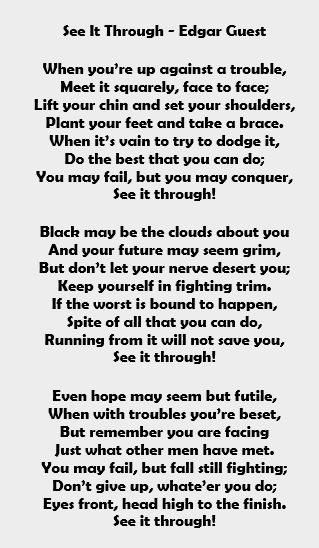
See It Through - Edgar Guest

When you’re up against a trouble,
Meet it squarely, face to face;
Lift your chin and set your shoulders,
Plant your feet and take a brace.
When it’s vain to try to dodge it,
Do the best that you can do;
You may fail, but you may conquer,
See it through!

Black may be the clouds about you
And your future may seem grim,
But don’t let your nerve desert you;
Keep yourself in fighting trim.
If the worst is bound to happen,
Spite of all that you can do,
Running from it will not save you,
See it through!

Even hope may seem but futile,
When with troubles you’re beset,
But remember you are facing
Just what other men have met.
You may fail, but fall still fighting;
Don’t give up, whate’er you do;
Eyes front, head high to the finish.
See it through!

🔆 Read more Poems

Adblock test (Why?)